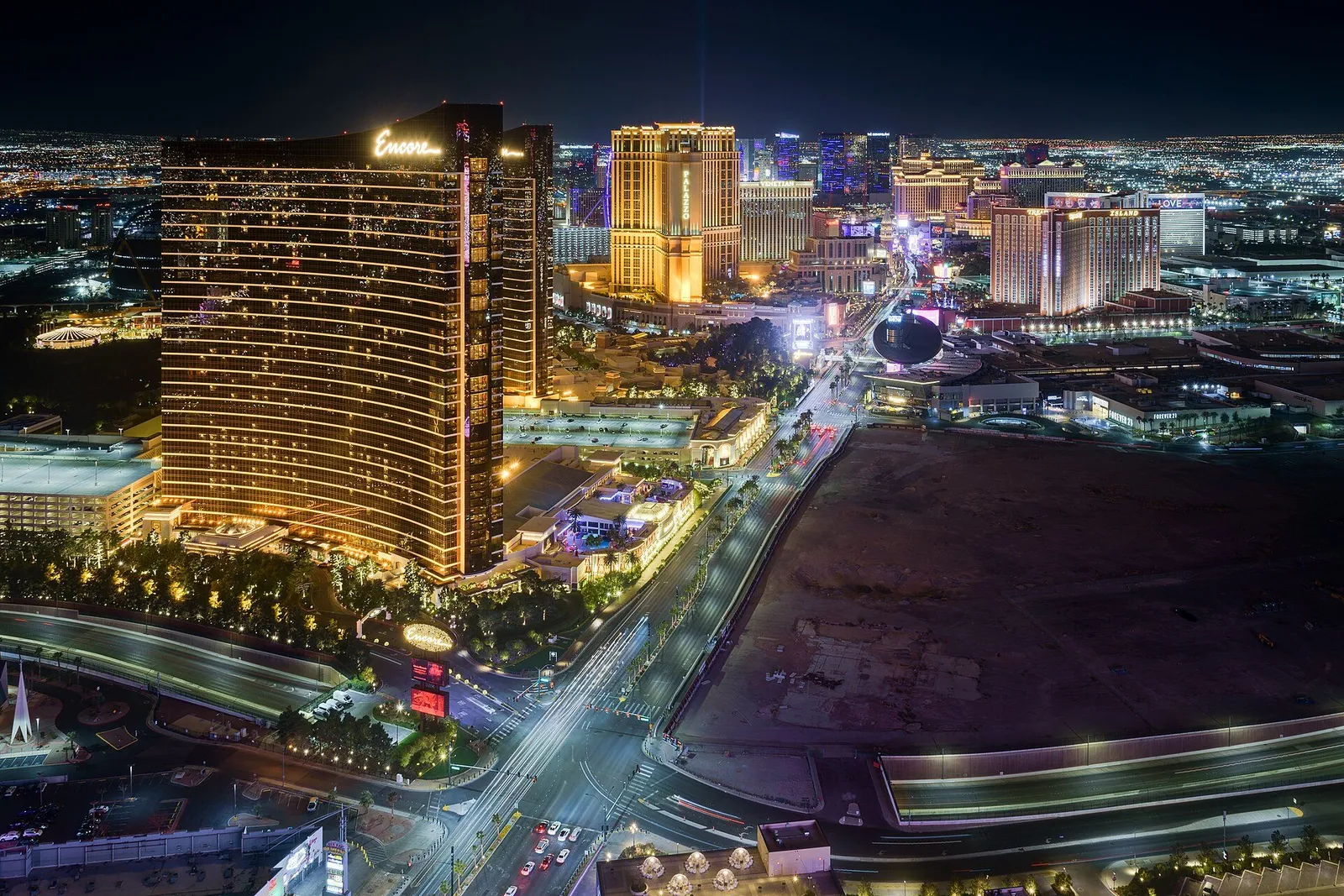
Las Vegas is the most theatrical city in America: a strip of casino resorts rising straight out of the Mojave Desert, built on the promise that everything gets bigger at night. The core experiences cost little or nothing: the free Bellagio fountains, the Fremont Street canopy light shows, people-watching on the Strip, and canyon and dam country within an hour's drive. Inside the resorts you will find arena residencies, big-spender dining, and pools that double as dayclubs. Vegas suits first-time US travelers who want one concentrated burst of American excess, and it rewards a plan: the free stuff is the best stuff, the desert is the antidote to the casino floor, and everything is cheaper when you book shows and tours before you arrive.
Top sights at a glance
The Las Vegas Strip
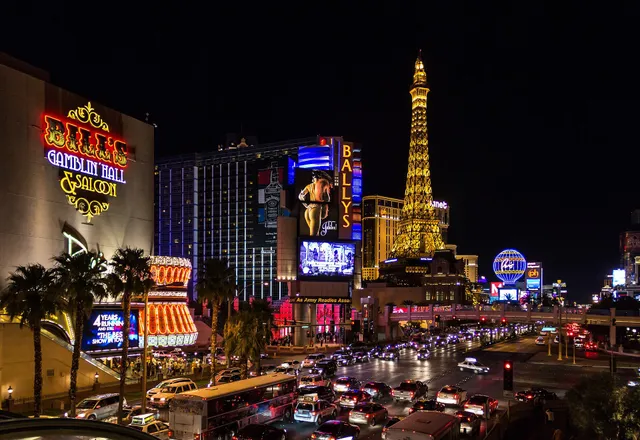
The Strip is not one place but a four-mile parade of self-contained fantasy worlds: a Venetian canal, an Eiffel Tower, a sphere that plays with your sense of scale. Walking it is the essential free experience, especially after dark when the resorts compete for your attention with fountains, volcano reproductions, and block-long video screens. Distances are longer than they look and the heat is real, so break the walk into two or three sections and use the free pedestrian bridges at the major intersections.
Good to know · Start at the Bellagio fountains and walk south toward the Sphere, roughly two hours with stops. The Las Vegas Monorail skips the slog on the east side: a single ride is $6.25 (or $5.75 in the online app) and a 24-hour pass is $15.50, as of October 2026, bought at lvmonorail.com. The RTC Deuce bus crawls the whole Strip and downtown around the clock; check current fares at rtcsnv.com before you go.
Fountains of Bellagio
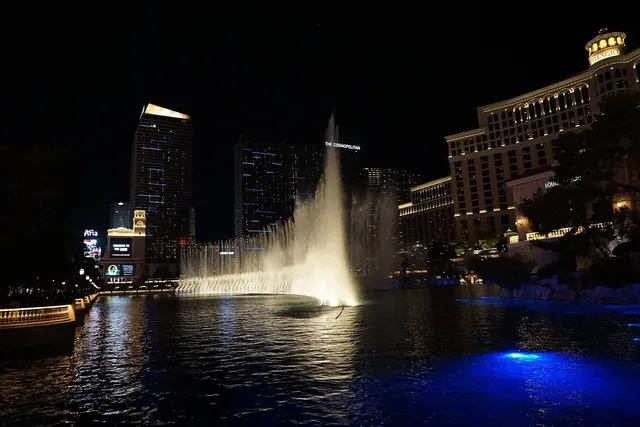
A nine-acre lake in front of the Bellagio erupts in choreographed water, light, and music: 1,214 nozzles shooting streams as high as 460 feet. Shows are free and usually run every half hour from the afternoon until around midnight, with the evening performances lit and slightly more frequent. It is the single most Vegas thing you can do without opening your wallet, and the sidewalk railing across the lake is the classic vantage point.
Good to know · Free, as of October 2026; shows are canceled in high wind, so build in a second chance. Cross Las Vegas Boulevard to the railing in front of Paris for the full lake in frame, or arrive 15 minutes before a night show for a front spot. Confirm same-day times on the fountain page at bellagio.mgmresorts.com.
Fremont Street Experience
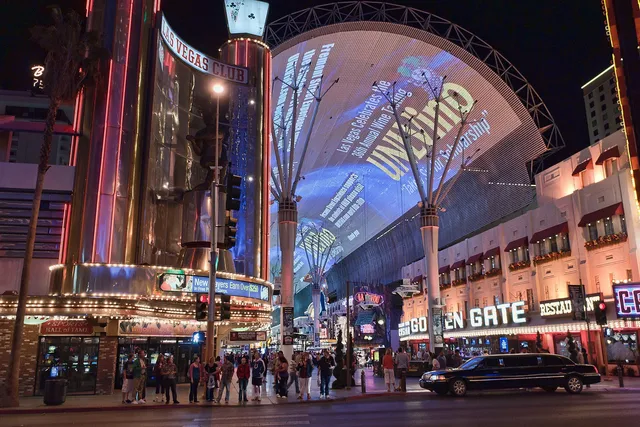
Downtown's Fremont Street is the older, louder, cheaper Las Vegas: five blocks of neon-era casinos under a 90-foot video canopy called Viva Vision that runs sound-and-light shows every night. Free concerts play on stages along the mall most evenings, the people-watching is unmatched, and the SlotZilla zipline launches riders down the middle of the street from a slot-machine-shaped tower. It is scruffier than the Strip and proud of it.
Good to know · The district is open around the clock and the light shows run after dark into the early hours; check that night's schedule at fremontstreetexperience.com. From the Strip it is a 15-20 minute drive or the Deuce bus. Zipline tickets are sold on-site and online; book a day ahead on busy weekends.
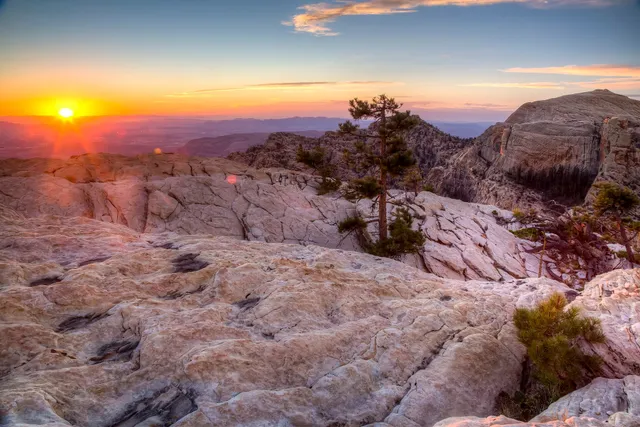
Red Rock Canyon
Twenty-five minutes west of the Strip, the Mojave tilts upward into a 3,000-foot wall of Aztec sandstone: red, banded, and absurdly photogenic. The 13-mile Scenic Drive loops past trailheads for short walks (Calico Hills, the Petroglyph Wall) and long ones, and the visitor center explains the geology you are looking at. It is the antidote to casino air and the best half-day trip in the valley.
Good to know · Entry is $20 per vehicle as of October 2026, paid at the gate. From October 1 through May 31, 8 a.m. to 5 p.m., the Scenic Drive requires a timed-entry reservation booked at recreation.gov (a small per-vehicle booking fee applies); arriving before 8 a.m. or after 5 p.m. avoids the reservation entirely. Carry more water than seems reasonable; see the safety note below.
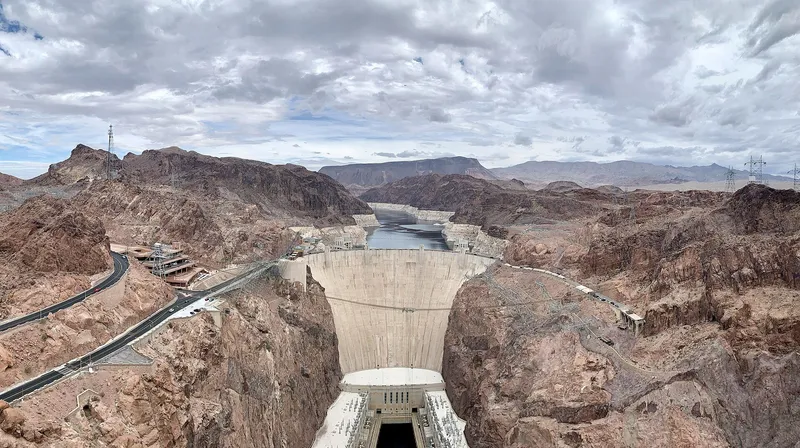
Hoover Dam
Built during the Depression in five years, the dam that tamed the Colorado River and powered the Southwest is 45 minutes from the Strip and still thrillingly massive: 726 feet of poured concrete braced between black canyon walls. The visitor center exhibits and observation deck explain the engineering, and the Mike O'Callaghan-Pat Tillman Memorial Bridge viewpoint gives you the postcard shot of the dam's face from 890 feet above the river.
Good to know · The Power Plant guided tour runs about $25 for adults and $15 for ages 4-16, and the self-guided visitor center ticket is $15, as of October 2026, bought online at the ticketing link on usbr.gov/lc/hooverdam/. Note: the full Guided Dam Tour was suspended in August 2026 for elevator repairs, so check the official site for its status. Arrive before 11 a.m. to beat tour-bus lines, and expect a vehicle inspection at the Nevada checkpoint.
See it in motion
Some places earn a moving picture
Stills can't show how this place moves: the drift, the light show, the crowd flow. We picked a recent, high-quality walkthrough rather than a promotional cut.
Las Vegas Strip Walking Tour | October 2026 [4K HDR]
4K WALK NATION · YouTube · plays on click
Embedded via YouTube's official player (privacy-enhanced mode). Video: Las Vegas Strip Walking Tour | October 2026 [4K HDR] by 4K WALK NATION. Not affiliated with Wide Open America; screened for quality and accuracy on 2026-10-15.
Las Vegas is the most theatrical city in America, and it does not pretend otherwise. A handful of casino resorts larger than most European towns rise out of the Mojave Desert, each one its own climate-controlled universe of fountains, canals, and corridors designed so that you never quite notice the time. The pleasant surprise for first-time visitors is how much of it is free: the fountains, the Fremont Street light shows, and the best show on the Strip, which is the Strip itself, a four-mile parade of people who all came here to feel lucky. Give it three or four days, mix in one desert day, and treat the whole thing as a spectacle you walk through rather than a slot machine you feed.
A Bit of History
The location made no sense, which is the point. Las Vegas sat on the Spanish Trail route to California as a desert watering hole, then as a railroad water stop in 1905, useful to exactly two groups: railroads and nobody else. Two decisions in 1931 turned it into a city. Nevada legalized gambling, and the federal government started building Boulder Dam (today’s Hoover Dam) nearby, importing thousands of workers with wages, no families yet, and nothing to do at night. Casinos and show halls opened downtown on Fremont Street to serve them, and the pattern was set: an economy of entertainment bolted onto the desert.
The mob era followed in the 1940s, when East Coast crime money banked the Flamingo and its successors on the highway south of downtown, the Strip. The corporations took over in stages from the 1960s onward, and by 1989, when the Mirage opened with a volcano out front, the business model had become what it still is: sell rooms at or below cost, and let restaurants, shows, clubs, and the casino floor do the earning. Each era left architecture behind, from the neon signs now gathered in the Neon Museum’s boneyard to the themed megaresorts of the 1990s and the glass towers of the 2020s.
The city’s most recent chapters are visible from any rooftop: the Sphere opened in 2023 as the most expensive concert venue ever built, and Formula 1 has raced down the Strip every November since 2023, briefly turning the boulevard into a street circuit. The metropolitan area now holds about 2.3 million people, and it welcomes tens of millions of visitors a year: tourism is not the city’s industry but its entire weather system.
Culture & Daily Life
Las Vegas runs on rules, and the first one is age. You must be 21 to gamble, drink, or even stand at a casino bar, and casino floors check identification aggressively: carry a passport or driver’s license whenever you plan to order a drink, because a look that would pass in London will not pass at a Vegas bar. The federal minimum drinking age of 21 applies everywhere in the US (see 23 USC 158), and Nevada enforces it. If your group includes anyone under 21, plan your evenings around pool decks, shows, and restaurants instead.
Money has its own etiquette. Tipping is not optional: 18-22 percent for table service, $1-2 per drink at a bar, and a dollar or two for the cocktail servers who bring free drinks on the casino floor (the drinks are free while you are gambling; the tips are how the system works). Menu prices exclude sales tax, so a $30 dinner lands closer to $33; our /tools/real-price-calculator/ explains the pattern. Then there is the resort fee, the city’s favorite fine print: most resorts add a mandatory daily charge, commonly in the $30-60 range plus tax, on top of the room rate you saw advertised. Read the itemized total on the payment screen before you book, not after.
Casinos have no clocks and few windows because the design works: give yourself an alarm-based budget and check the clock when you cross a threshold. Security is everywhere and professional; you may see news coverage of gun issues in America, but the practical reality for a traveler is that casinos, shows, and the airport are heavily screened, guns are barred from most of them, and following staff directions settles everything. The locals’ city beyond the resorts is normal suburban America: Summerlin strip malls, Chinatown noodle houses, and weather that decides the rhythm of the year. From June through September, highs sit near or above 100F (38C); locals cross parking lots at a jog and treat evening as the outdoor season. Do the same.
Nature & the Outdoors
The desert around Las Vegas is the city’s escape hatch, and locals use it constantly. Red Rock Canyon, on the western edge of the valley, is the headline: a conservation area of sandstone cliffs, dry washes, and desert tortoise habitat with road and trail access detailed in the sights section below. Lake Mead, the reservoir behind Hoover Dam, adds boating and shoreline drives to the east, and the Spring Mountains (including Mount Charleston, over 11,900 feet) hold pine forests and cooler air 45 minutes from the Strip, a strange and useful fact in July.
The heat is the one thing that hurts unprepared visitors. Summer hiking after 10 a.m. is genuinely dangerous: the National Park Service and local rangers run rescues every summer for travelers who started Red Rock trails at noon with one water bottle. Start at dawn, carry a liter of water per hour of walking, and treat any trail in July and August as an early-morning proposition. One more practical note: visitors do not have cheap access to US healthcare, and an emergency room visit without insurance can cost hundreds to thousands of dollars, so confirm your travel insurance covers medical care before you go; our /guides/health-insurance-safety/ guide covers the details.
Food & Drink
Vegas eating runs from the sublime to the all-you-can-eat, sometimes in the same building. The high end is serious: the Strip holds more celebrity-chef tasting rooms per mile than anywhere in the country, and a splurge dinner of $150-300 per person is a standard order. The middle is where travelers should live, though: Chinatown along Spring Mountain Road, just west of the Strip, is arguably the best eating value in the city, with regional Chinese, Vietnamese, and Thai kitchens at $15-25 per person. The old-school buffet, the defining Vegas meal, has thinned out since 2020 but survives at several resorts; expect $40-80 per person at the better ones, and treat it as theater rather than value.
Breakfast is the traveler’s cheap lever: casino cafes and coffee shops serve substantial American breakfasts for $15-25, and food halls in the newer resorts do bowls and sandwiches around $18-25. Happy hour is a real institution here, with drink discounts that start absurdly early because the city never wakes up.
Drinking rules deserve respect: you must be 21 with ID for anything alcoholic, open containers are generally tolerated in casino corridors but regulated elsewhere, and Strip-sized frozen drinks can hit $25. Tip 18-22 percent at restaurants, $1-2 per drink at bars, and 10-15 percent for delivery; the full math lives in /guides/tipping-and-sales-tax/.
Top Sights
The Las Vegas Strip
The Strip is the attraction, and walking even part of it at night is non-negotiable. The classic route runs from the Bellagio fountains south past Paris (under its own Eiffel Tower), the Bellagio Conservatory, and the fountains of Caesars Palace, ending at the Sphere, whose exterior screen is itself a nightly show. Expect crowds, promoters handing out club cards, and street performers who expect a dollar for a photo. Distances deceive: Bellagio to the Sphere is about a mile, but the heat, the crowd pacing, and the traffic lights stretch it, so use the elevated pedestrian bridges at Flamingo and Harmon.
When walking loses its charm, two machines help. The Las Vegas Monorail runs above the Strip’s east side from the Sahara to MGM Grand: $6.25 per ride or $15.50 for a 24-hour pass, as of October 2026, with cheaper mobile tickets at lvmonorail.com. The RTC Deuce double-decker bus grinds up and down Las Vegas Boulevard around the clock and continues downtown to Fremont Street; it is slow but it runs all night, and current fares are posted at rtcsnv.com.
Budget-wise, the Strip is free to enter and expensive to linger in. Walking it costs nothing; a frozen daiquiri costs $20; and every resort lobby is itself a museum of ambition, from the Venetian’s painted sky to the Caesar statuary. Do the walk twice, once at dusk and once after 10 p.m., and you will have seen the real show.
Fountains of Bellagio
The fountains are the city’s signature and the best free 15 minutes in America. A lake in front of the Bellagio fires 1,214 water nozzles in time to opera, pop, and patriotic standards, with streams reaching 460 feet; shows typically run every half hour from afternoon until around midnight, slightly more frequently in the evening, as of October 2026. Wind cancels shows, so if you have your heart set on a song, give yourself a second window.
The viewing logistics are simple. The sidewalk railing directly across Las Vegas Boulevard from the lake is the best free vantage; arrive 15 minutes early for the popular evening songs. The Bellagio’s own terraces put you closer for the price of a drink, and the surrounding block rewards a loop: the Conservatory next door (free, seasonal displays) and the Chihuly ceiling in the lobby are worth 30 minutes on their own.
One warning: the fountains anchor the busiest corner of the Strip, and rideshares around there crawl after 8 p.m. Walk in, then walk out. The fountain schedule and occasional seasonal variants are posted on the Bellagio’s entertainment page at bellagio.mgmresorts.com.
Fremont Street Experience
Downtown Fremont Street is what Las Vegas looked like before the megaresorts, wrapped in what it looks like now. Five blocks of the old casino district (the Golden Nugget, the 1950s-era Neon Museum signs still spinning) sit under Viva Vision, a canopy of LED screens 90 feet above the street that runs free sound-and-light shows every night, with the programming heaviest after dark. Live bands play outdoor stages most evenings, also free, and the whole thing is open around the clock, as of October 2026.
SlotZilla, the zipline tower shaped like a slot machine, sends riders under the canopy above the crowds; lower riders land partway down the mall and the upper line carries you seven blocks. Buy tickets on-site or online a day ahead for weekends; prices are posted at fremontstreetexperience.com/slotzilla/.
Getting downtown is a 15-20 minute drive from the Strip, or the Deuce bus. Fremont is grittier and cheaper than the Strip, and that is the point: $10 table minimums, $6 cocktails, and a crowd that came to gamble rather than photograph. Go after 8 p.m. when the canopy is at full brightness.
Red Rock Canyon
Red Rock Canyon National Conservation Area is where locals go to remember the desert is not a parking lot. A 13-mile one-way Scenic Drive loops along the base of a 3,000-foot sandstone escarpment, with overlooks and trailheads the whole way: the Calico Hills walk (one to two miles, up close with the red rock), Petroglyph Wall, and longer hikes into Ice Box Canyon. The visitor center’s outdoor exhibits decode the geology, and wildlife (bighorn sheep, if you are lucky) shows up on the early loops.
Practicalities matter here. Entry is $20 per vehicle, as of October 2026. Between October 1 and May 31, from 8 a.m. to 5 p.m., you need a timed-entry reservation for the Scenic Drive, booked at recreation.gov (search “Red Rock Canyon Scenic Drive”); the reservation releases 30 days ahead, and a same-day option usually appears. Arrive before 8 a.m. or after 5 p.m. and no reservation is needed, which is how locals do it anyway.
There is no shade worth mentioning and no water on the trails: carry a liter per hour, wear a hat, and skip midday in summer. It is a 25-minute drive from the Strip; a rental car makes this easy, and tour shuttles cover it if you would rather not drive.
Hoover Dam
Hoover Dam is the Depression’s answer to a cathedral: 726 feet of concrete poured between 1931 and 1936, holding back the Colorado River and powering three states. The visit works in layers. The visitor center’s exhibits and elevator take you into the guts of the power plant on the guided Power Plant Tour ($25 adults, $15 for ages 4-16, as of October 2026), the self-guided ticket ($15) covers the exhibits and observation deck, and the dam itself is free to walk across, straddling the Nevada-Arizona time zone line.
Two useful notes for 2026. First, the full Guided Dam Tour (tunnels and elevators to the top) was suspended in August 2026 pending elevator repairs; check the notice at usbr.gov/lc/hooverdam/ before you go. Second, the best photograph is not from the dam but from the Mike O’Callaghan-Pat Tillman Memorial Bridge on the Arizona side: a 15-minute walk up from the parking area to a platform 890 feet above the river, looking straight down at the dam’s Art Deco face.
Logistics: 45 minutes from the Strip by car (tours and shuttles run constantly), with a security checkpoint where all vehicles are subject to inspection; the site is open daily from 5 a.m. to 9 p.m., and the visitor center runs 9 a.m. to 5 p.m. with the last tour at 4:10 p.m. Book the Power Plant Tour online the morning of your visit; the least crowded windows are 9 to 11 a.m. and 2:30 to 3:45 p.m.
Getting There & Around
Harry Reid International Airport (LAS) sits absurdly close: 15 minutes from the Strip by taxi or rideshare, $20-35 depending on the hour. There is no rail link; public RTC buses run, but with luggage you will want a cab. Driving from downtown Los Angeles takes about four hours, and from Phoenix about 4.5.
In town, you have three tools. Walking covers any single resort cluster, and the pedestrian bridges cross the boulevard safely. The monorail (east-side resorts, $6.25 per ride as of October 2026) and the Deuce bus (the whole Strip and downtown, around the clock) cover the length. Rideshare fills the gaps, though Strip pickup zones add 10-15 minutes at peak times.
A rental car is only worth it for Red Rock Canyon, Hoover Dam, and Valley of Fire day trips; if that is your plan, rent from the airport and check whether your resort charges daily parking, which most Strip resorts do.
Where to Stay
The center of the Strip (Bellagio to Caesars Palace) is the location play: walkable to the fountains, the best shows, and the monorail, at the highest nightly rates plus the largest resort fees. Choose it for a first visit built around nightlife and spectacle.
The north Strip (around Sahara Avenue and the Convention Center) is the value play: newer towers, monorail access, noticeably lower rates, and a 15-minute walk or one monorail stop to the middle of the action. Downtown (Fremont Street) is the budget play: cheaper rooms, cheaper food, everything lit and walkable, at the cost of a 15-20 minute ride to the Strip. Whichever you pick, the same warning applies: Strip resorts add a mandatory resort fee (commonly $30-60 plus tax per night, as of October 2026) that is rarely in the advertised rate, and most charge for self-parking. Compare the itemized total before you pay, not the headline price.
Sources & verification (12)
- https://www.redrockcanyonlv.org/fees/
- https://www.redrockcanyonlv.org/plan/timed-entry-reservations/
- https://www.usbr.gov/lc/hooverdam/service/index.html
- https://www.usbr.gov/lc/hooverdam/
- https://www.lvmonorail.com/ticket-information/
- https://bellagio.mgmresorts.com/en/entertainment/fountains-of-bellagio.html
- https://en.wikipedia.org/wiki/Fountains_of_Bellagio
- https://fremontstreetexperience.com/
- https://fremontstreetexperience.com/slotzilla/
- https://www.law.cornell.edu/uscode/text/23/158
- https://thepointsguy.com/news/las-vegas-resort-fees/
- https://en.wikipedia.org/wiki/RTC_Transit