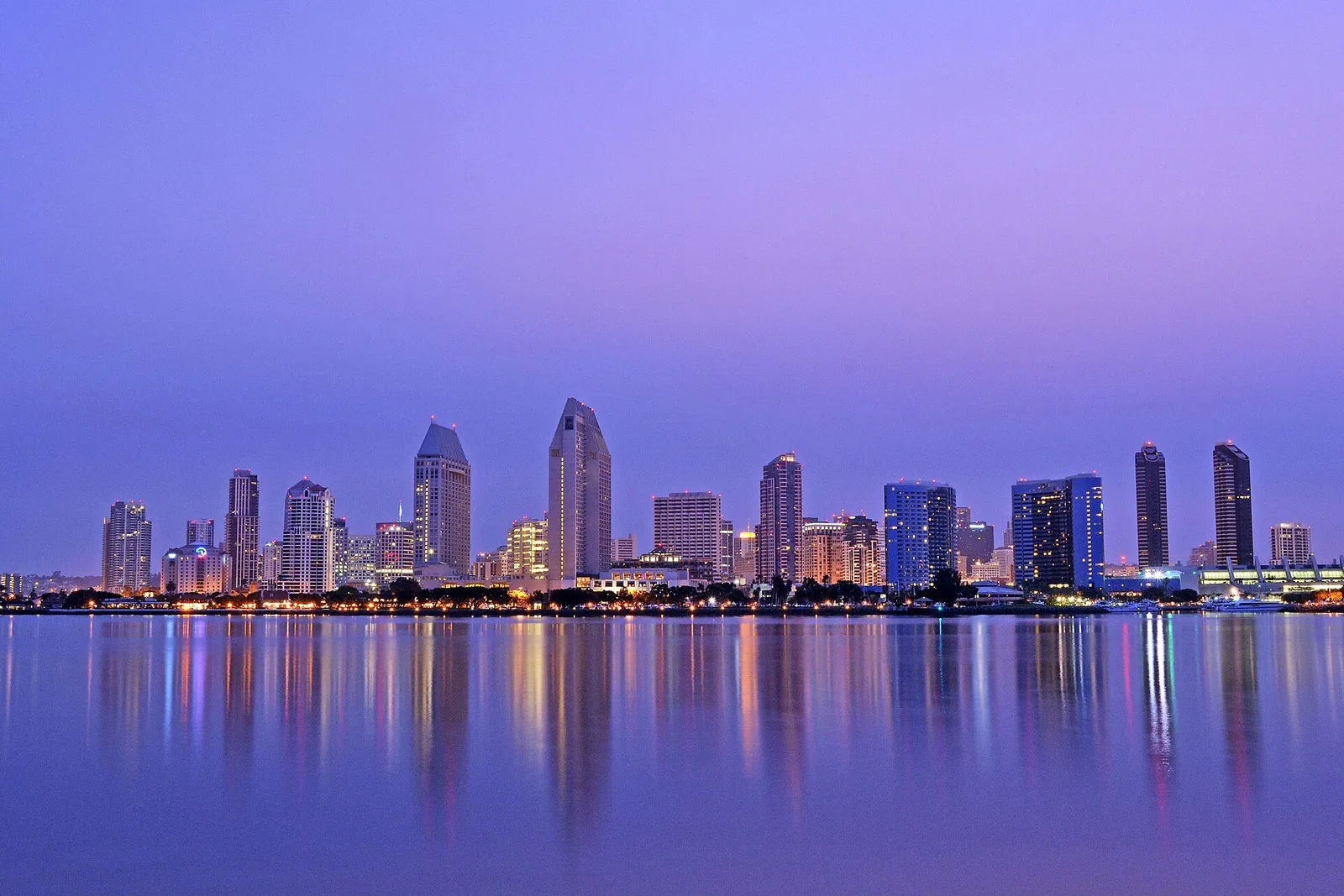
San Diego is the easygoing counterweight to Los Angeles, and for first-time US travelers it is the simplest big city in California to enjoy. The essentials line up along one bay and one park: the Spanish Colonial architecture and museums of Balboa Park, the world-famous San Diego Zoo inside it, the aircraft carrier USS Midway moored downtown, sea lions barking off the cliffs of La Jolla Cove, and the Victorian fantasy of Hotel del Coronado across a short ferry ride. The weather stays mild enough for the beach most of the year, the airport sits minutes from downtown, and a car is optional rather than essential. Give it three or four days, split them between the park and the coast, and book nothing else in advance except the things children insist on.
Top sights at a glance
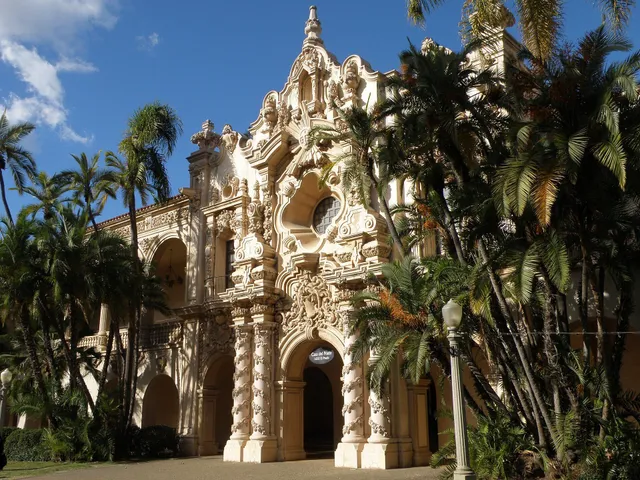
Balboa Park
Balboa Park is the cultural heart of the city: 1,200 acres of gardens, plazas, and Spanish Colonial Revival buildings erected for the 1915 Panama-California Exposition, now holding more than a dozen museums, the Old Globe theaters, street performers on El Prado, and the San Diego Zoo at its center. The park itself is free to enter, and the architecture alone justifies a morning.
Good to know · Entry to the park grounds and gardens is free; individual museums charge separately, or you can buy a Balboa Park Explorer Pass through balboapark.org. As of October 2026 the city charges for parking in the central lots during daytime hours, with some outlying lots free; check the posted rates before you drive.
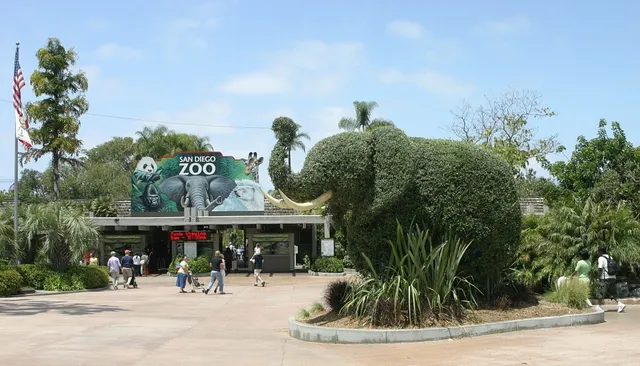
San Diego Zoo
Founded in 1916 around animals left from the Panama-California Exposition, the San Diego Zoo pioneered cage-less, open-air exhibits and grew into the most visited zoo in the United States, holding more than 12,000 animals across some 680 species on about 100 acres of canyon terrain. The included guided bus tour and the Skyfari aerial tram solve the hills and give the best overview.
Good to know · As of October 2026, the 1-Day Pass costs $78 for adults (12+) and $68 for children 3-11, with online-only Value Days a few dollars cheaper; no reservation required. Buy at zoo.sandiegozoo.org to skip the line. Arrive at the 9 a.m. opening for active animals and thinner crowds, and wear real walking shoes.
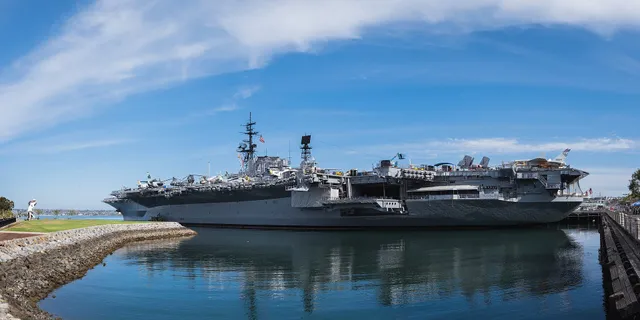
USS Midway Museum
The longest-serving American aircraft carrier of the twentieth century, commissioned in 1945 and decommissioned in 1992, now floats downtown as the most visited warship museum in the country. A self-guided audio tour recorded by former Midway sailors threads more than 60 locations, from the bridge to the brig, and the flight deck stacked with aircraft above San Diego Bay is one of the great photos in California.
Good to know · As of October 2026, general admission is $39 online ($41 at the door) for ages 13+, $29 ($31) for youth 4-12, free for active-duty military and children 3 and under; the audio tour is included. Open daily 10 a.m. to 5 p.m. with last admission at 4 p.m., closed Thanksgiving and Christmas. Plan three hours minimum.
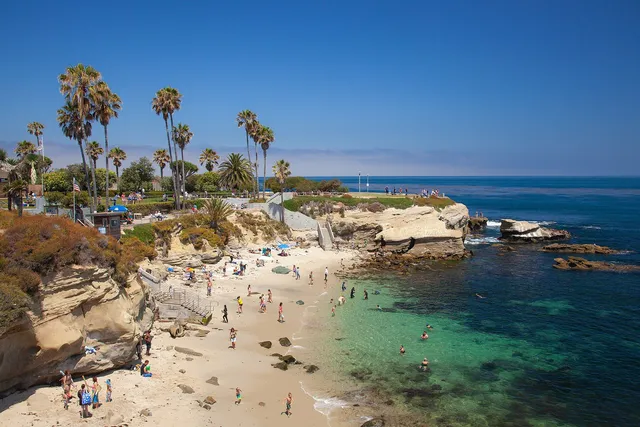
La Jolla Cove
The Cove is a small, north-facing beach tucked between sandstone cliffs at the edge of the San Diego-La Jolla Underwater Park Ecological Reserve, where fishing is banned and marine life flourishes. Clear water can exceed 30 feet of visibility, California sea lions haul out on the rocks of Point La Jolla, and the cliffside walk north to the Children's Pool seal beach is one of Southern California's great free afternoons.
Good to know · Free to visit, with a permanent lifeguard station, restrooms, and showers; arrive before 10 a.m. for parking and calm morning water, as of October 2026. Keep at least 50 feet from seals and sea lions; they are protected, and rangers close access when females pup in spring. Snorkel rentals and kayak tours of the sea caves operate a block inland.
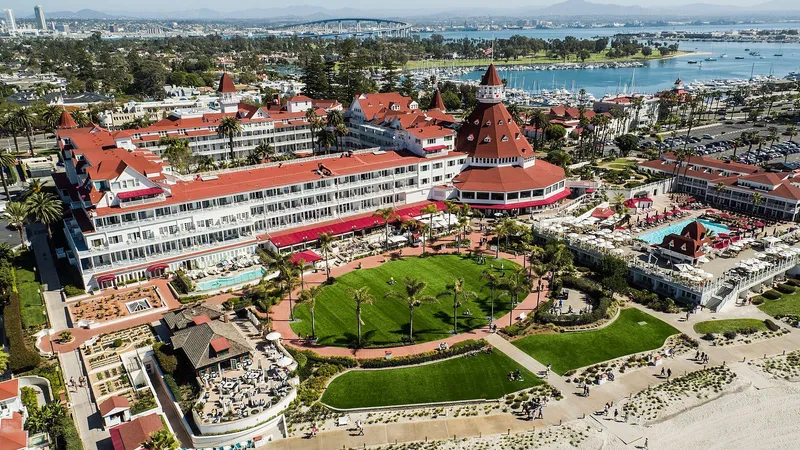
Coronado
The island-toned peninsula across San Diego Bay keeps its own small-town pace, crowned by Hotel del Coronado, the wooden Victorian beach resort opened in 1888 that became a National Historic Landmark and hosted presidents and film crews alike. Miles of flat, gleaming sand face the ocean, the bayside path faces the downtown skyline, and the ferry from the Embarcadero makes the whole outing car-free.
Good to know · The Flagship ferry runs from Broadway Pier and the Convention Center to the Coronado Ferry Landing, roughly every 30-60 minutes, about $9 one way as of October 2026; bikes ride along. From the landing it is a flat mile to the Hotel Del and the beach. Sunset from the ferry, skyline behind you, is the ride to book.
San Diego is the California city that behaves like the postcard version of itself. The sun is reliable without being oppressive, the bay is ringed with things worth walking to, and the headline attractions, a century-old cultural park and a mothballed aircraft carrier, sound like brochure filler and turn out to be the reason you came. For first-time US travelers it is the gentlest introduction to an American big city: the airport sits ten minutes from downtown, the trolley and buses reach most of what matters, and the beach culture requires no equipment beyond a towel. San Diego rewards unhurried days. Give it three or four, split them between Balboa Park and the coast, add one afternoon for Coronado, and keep your evenings open for tacos and craft beer.
A Bit of History
Long before Spanish ships arrived, the San Diego region was home to the Kumeyaay people, whose villages stretched from the coast into the mountains and whose descendants remain a living presence in the county. In 1769 Spanish missionaries founded the Mission San Diego de Alcala, the first of the California missions, and the Mexican period left the town a small pueblo around what is now Old Town.
Modern San Diego moved downhill and south. In 1867 developer Alonzo Horton bought waterfront land, New Town boomed, and the Santa Fe Railroad’s arrival in 1885 set off a land rush that produced the city’s first grand hotels. The decisive moment came in 1915 and 1916, when the Panama-California Exposition filled a neglected city park with the ornate Spanish Colonial Revival buildings that now define Balboa Park; a second exposition followed in 1935 and 1936, and the park and its exhibition buildings were declared a National Historic Landmark District in 1977.
The twentieth century belonged to the military. San Diego’s harbor and mild flying weather made it a Navy and Marine Corps stronghold, home to the Pacific Fleet’s carriers and to North Island, a birthplace of American naval aviation. Charles Lindbergh’s Spirit of St. Louis was built here in 1927, and the Navy still shapes the city’s rhythm, from the ships along the Embarcadero to the sailors in any waterfront bar.
After World War II the economy broadened from tuna fleets to biomedical research, telecommunications, and defense contracting, anchored by the University of California, San Diego. Today the city counts roughly 1.4 million residents, California’s second largest, and wears its history lightly: the missions, the exposition palaces, and the carriers are all still in daily use.
Culture & Daily Life
San Diego’s culture starts with its weather: mild enough that locals schedule their lives outdoors year-round, with the city’s social geography following the coastline, surfers at dawn in Ocean Beach, families on Mission Bay’s lawns, joggers on the bayside path at dusk. The famous May Gray and June gloom coastal fog is real, with overcast late-spring mornings that burn off by noon, so do not judge the forecast before lunch.
The Mexican border runs twenty minutes south, and Mexican food and culture are not an enclave here but the city’s own foundation. California’s Spanish and Mexican past is visible in the place names, the mission architecture, and every taco shop in town. Military culture is the other constant; San Diego is a Navy town, and the carriers, bases, and ceremonies you might glimpse at the Midway are ordinary civic life. As for US gun politics you may have read about, the practical reality for visitors is simple: guns are barred from the places tourists go, and if you encounter security anywhere, follow their directions as you would at home.
Daily logistics are friendly. Casual dress works everywhere, including most restaurants. Tipping runs 18-22 percent at restaurants and $1-2 per drink at bars, with the full guide at /guides/tipping-and-sales-tax/. California’s sales tax adds roughly 8 percent at the register and hotel taxes and fees add more, so run the true totals through /tools/real-price-calculator/ before budgeting. Alcohol requires ID at 21, and the city’s craft breweries are strict about it.
Nature & the Outdoors
San Diego’s outdoors is the coastline. Seventy miles of beaches run from the Silver Strand in the south through Coronado, Point Loma, Ocean Beach, and Mission Bay to the Torrey Pines reserve, where one of the rarest pines on Earth clings to sandstone bluffs above a swimming beach. The water is cooler than tourists expect, typically in the 60s Fahrenheit even in summer, and morning surfs require a wetsuit much of the year.
The bay and the ocean shelter a surprising amount of protected nature. The San Diego-La Jolla Underwater Park reserve has let kelp forests, garibaldi fish, and seal populations thrive within swimming distance of downtown; gray whales pass the coast in winter, and kayak tours thread the La Jolla sea caves when the swell allows. Inland, Mission Bay’s calm water is the city’s paddling and picnicking heart, and Balboa Park’s gardens supply the green without leaving downtown.
Take the ocean seriously anyway. Rip currents are the real hazard on Southern California beaches, so swim near lifeguard towers and read the posted flags; jellyfish and cliff edges at La Jolla deserve ordinary care. One practical note covers all of it: US medical care is expensive without insurance, and an ER visit for something minor can cost hundreds to thousands of dollars, so carry travel medical cover before you get in the water; see /guides/health-insurance-safety/.
Food & Drink
San Diego eats like the border city it is, and its signature dishes were invented here. The fish taco, battered fried fish in a corn tortilla with cabbage and crema, came up the Baja coast to become the city’s default lunch; the California burrito, stuffed with carne asada, fries, cheese, and salsa, is a late-night institution; carne asada fries, a mountain of both on one plate, need no introduction beyond an appetite. None of this is fancy, and that is the point: the best versions come from taco shops the size of a garage for $4-6 an item, and locals argue about which one is best the way other cities argue about pizza.
Beyond the taco shops, the neighborhoods do the heavy lifting. Little Italy, downtown, turned its immigrant food heritage into one of the best restaurant and market streets in California; North Park and South Park carry the craft-beer-and-brunch scene; Ocean Beach and La Jolla keep the surf-town counters and harbor-view patios. The craft beer culture deserves its reputation: San Diego pioneered the West Coast IPA, breweries anchor whole blocks, and tasting flights run $8-15.
Budgeting sits mid-range for California: casual meals $12-20, good dinners $40-70, and happy hours everywhere worth using. Tipping is standard US practice, 18-22 percent for table service, $1-2 per drink, 10-15 percent for delivery, with the details at /guides/tipping-and-sales-tax/, and remember that menu prices gain roughly 8 percent sales tax at the register.
Top Sights
San Diego’s essentials cluster conveniently: two of the five sit inside Balboa Park, two line the downtown waterfront, and two more ride the coast north. Plan by area, not by list.
Balboa Park
Balboa Park is a city park that grew into a national treasure. Set aside as public land in 1835, making it one of the oldest such sites in the United States, it found its face with the 1915-16 Panama-California Exposition, whose Spanish Colonial Revival palaces of plaster and tile still line the central Prado. Today the park holds more than a dozen museums (natural history, air and space, art, folk art, the Comic-Con Museum among them), the Old Globe theaters, the giant Spreckels pipe organ, and gardens from rose beds to a lath-house botanical building.
The grounds are free, and a day can be spent entirely on the free layer: the architecture, the street musicians and painters on El Prado, the gardens, and the views over the canyons. Museums charge individually, as of October 2026, with the Balboa Park Explorer Pass from balboapark.org bundling several at a discount. One 2026 change matters if you drive: the city now charges for parking in the central Cultural District lots during daytime hours, with non-resident rates up to $16 a day and free trams linking the outlying lots; a settlement will end paid parking again from January 1, 2027. Come on a weekday morning, walk the Prado first, and save the museums for the afternoon heat or a rare rainy day.
San Diego Zoo
The San Diego Zoo is the rare attraction that lives up to a global reputation. It grew out of the animals left behind by the 1915 exposition, was founded in 1916 by surgeon Harry Wegeforth, and pioneered the open-air, moated exhibits that changed how zoos work. Today it holds more than 12,000 animals across some 680 species and subspecies on about 100 acres of canyon land in Balboa Park, and it remains the most visited zoo in the United States, run by the nonprofit San Diego Zoo Wildlife Alliance.
Practicalities make the visit. As of October 2026, the 1-Day Pass costs $78 for adults and $68 for children 3-11, includes the guided bus tour and the Skyfari aerial tram, and needs no reservation; discounted Value Days sell online only at zoo.sandiegozoo.org. Enter at the 9 a.m. opening, when animals are most active, ride the bus tour first for the lay of the land, and then walk the canyon paths down to the elephants and the gorillas. The terrain is steep, so wear real shoes and use the tram to skip the worst climbs. Allow five to six hours, more with children.
USS Midway Museum
The USS Midway is the museum you did not know you wanted to spend half a day on. Commissioned a week after the end of World War II in 1945, then the largest ship afloat, the Midway served 47 years, the longest of any American carrier in the twentieth century, with about 200,000 sailors passing through her decks; her helicopters flew the evacuation of Saigon in 1975, and her aircraft struck targets in Operation Desert Storm in 1991. Decommissioned in 1992, she opened as a museum on the downtown Embarcadero in 2004 and became the most visited warship museum in the United States.
The included audio tour, narrated by former Midway sailors through more than 60 locations, threads sleeping quarters, the galley, the brig, primary flight control, and the hangar deck of restored aircraft, with flight simulators and a Battle of Midway theater for children. Docents, many of them veterans who served aboard, answer questions on deck. As of October 2026, admission is $39 online ($41 at the door) for ages 13+, $29 for youth 4-12, and free for active-duty military and children 3 and under; hours run 10 a.m. to 5 p.m. daily with last entry at 4 p.m., closed Thanksgiving and Christmas, per midway.org. The flight deck at sunset light is the photograph to plan around.
La Jolla Cove
La Jolla Cove is the wild edge of this polite city. The Cove itself is a small beach between sandstone cliffs, protected as part of the San Diego-La Jolla Underwater Park Ecological Reserve, where fishing is prohibited and the marine life has rebounded accordingly; the city’s lifeguards keep a permanent station here, and on clear days the water visibility can exceed 30 feet, which is why snorkelers and divers favor it. California sea lions crowd the rocks of adjacent Point La Jolla, barking, jostling, and ignoring their audiences with total confidence.
Come early: parking in the village tightens by mid-morning, the light is best on the cliffs, and the water is calmest before the afternoon breeze. Walk the coast path north past the Children’s Pool, the small seawalled beach where harbor seals haul out, and watch from the bluff rather than approaching; the animals are protected under federal law, and distances and seasonal closures are posted and enforced. Swimming is genuinely good in small summer surf, but the rocks are slippery and waves arrive in sets, so watch two cycles before committing. Pair the Cove with lunch in the village and the Torrey Pines bluffs a few miles north.
Coronado
Coronado is the day trip that feels like a scene change. The Ferry Landing docks face the downtown skyline fifteen minutes by boat, yet the town moves at a slower century: flat streets, ordered cottages, and the gleaming crescent of Coronado Central Beach, regularly ranked among the country’s finest. At its southern end stands Hotel del Coronado, opened in 1888 as the largest resort hotel in the world, a wooden Victorian fantasy that became a National Historic Landmark in 1977 and has hosted presidents, royalty, and film crews ever since.
The classic outing needs no car. Take the Flagship ferry from the Broadway Pier or the Convention Center dock (roughly every 30-60 minutes, about $9 one way as of October 2026), rent or bring bikes at the Landing, and ride the bayside path down to the Hotel Del, where the beach stretches for more than a mile toward Point Loma. Non-guests can walk the hotel’s grand lobby and porches, and the beachfront in front of the hotel is the sunset spot. Much of the island’s northern end is Naval Air Station North Island, an active base, so keep to public roads and beaches. Time your return for the evening ferry with the skyline ahead of you; it is the best nine-dollar view in California.
Getting There & Around
San Diego International Airport (SAN) sits three miles from downtown, one of the closest major airports to a city center in the country; a taxi or rideshare to the Gaslamp Quarter runs about $15-25, and public buses reach downtown for a few dollars. There is no rail link to the airport yet, though a planned line is in development, so budget the short ride.
The city itself works surprisingly well without a car. The MTS trolley connects downtown with Old Town, Mission Valley, and the Mexican border at San Ysidro, and buses serve Balboa Park (routes 7 and 215) and the coast. Downtown, Little Italy, and the Embarcadero are flat and walkable. Rent a car for La Jolla, Torrey Pines, and the north coast beaches, or accept frequent bus and rideshare rides; hotel parking runs $30-60 a night, which weighs against renting. For Coronado the ferry plus bikes beats driving; for day trips farther out, such as Temecula or the deserts, a single-day rental is the honest answer.
Where to Stay
The Gaslamp Quarter and adjacent East Village are the practical base: restaurants and nightlife in the historic blocks, Petco Park and the Midway within a walk, and the trolley at the doorstep. Choose it for first-visit logistics; expect noise on weekends. Little Italy is the refined version of the same idea, with the best food density in the city and a calmer street scene, an easy walk to the Embarcadero and the Midway.
For the beach version of the trip, La Jolla and Coronado are the two candidates: La Jolla for the coves, cliffs, and upscale village feel; Coronado for the wide sand and the quiet streets, both pricier than downtown rooms. Mission Valley is the budget play, with mall-adjacent hotels and trolley access at the cost of charm.
Three cost checks apply everywhere. Resort fees appear on many coastal properties, so price the total, not the headline rate, with /tools/real-price-calculator/. California hotel taxes add a noticeable chunk to any booking. Book early for summer and convention-heavy weeks; downtown rooms move first when the calendar fills.
Sources & verification (13)
- https://balboapark.org/plan-your-visit/
- https://balboapark.org/parking/
- https://zoo.sandiegozoo.org/tickets
- https://zoo.sandiegozoo.org/plan-your-visit
- https://www.midway.org/visit/buy-tickets
- https://www.midway.org/visit/our-exhibits
- https://www.sandiego.gov/lifeguards/beaches/cove
- https://www.flagshipsd.com/coronado-ferry
- https://en.wikipedia.org/wiki/Balboa_Park,_San_Diego
- https://en.wikipedia.org/wiki/San_Diego_Zoo
- https://en.wikipedia.org/wiki/USS_Midway_Museum
- https://en.wikipedia.org/wiki/Hotel_del_Coronado
- https://en.wikipedia.org/wiki/USS_Midway_(CV-41)