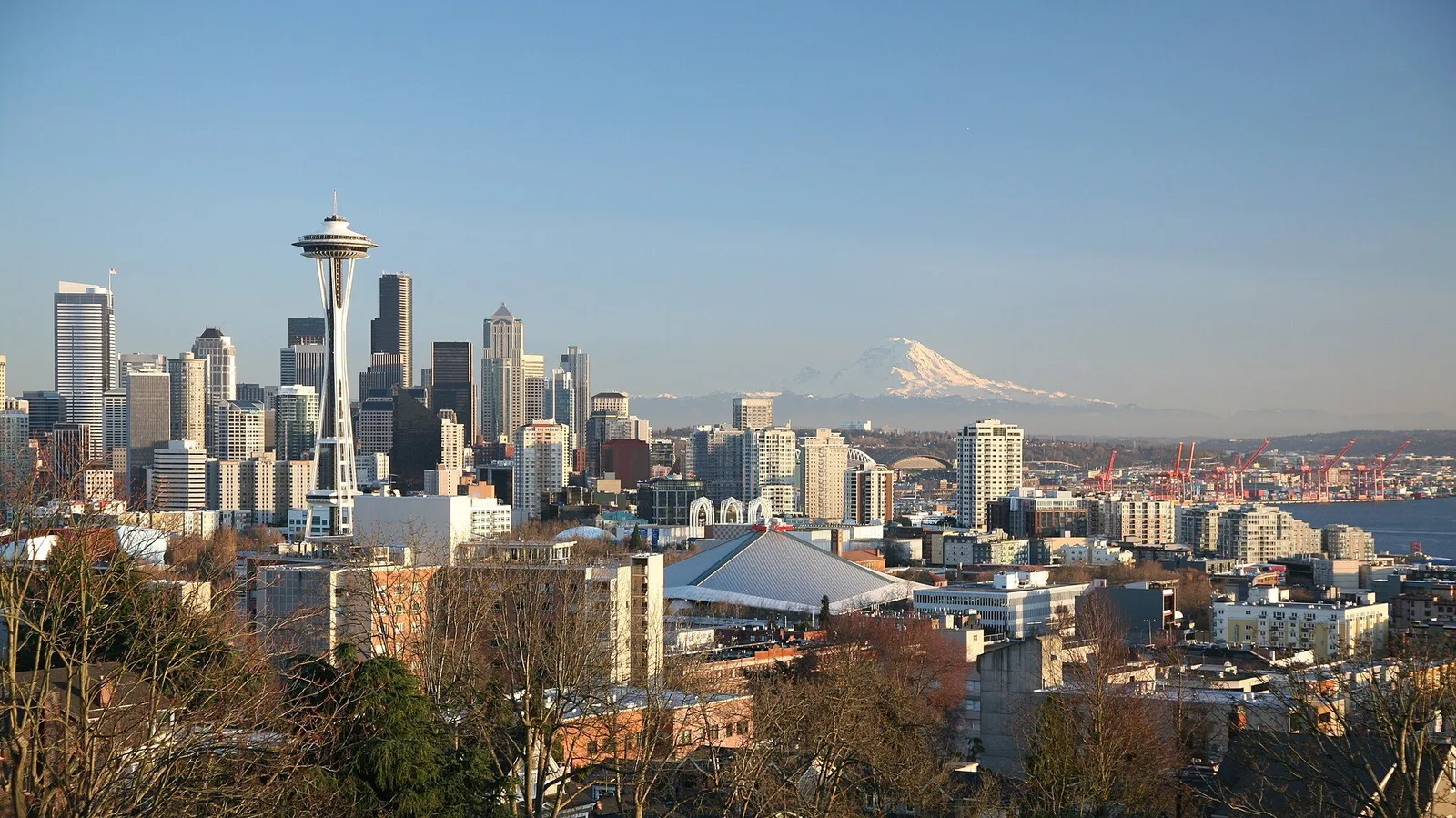
Seattle is the Pacific Northwest's anchor city, built on a narrow strip of land between Puget Sound and Lake Washington with a volcano on the horizon. The essential experiences are all close together: watching fish fly at Pike Place Market, riding an elevator of glass 605 feet up the Space Needle, catching the skyline at Kerry Park, walking through Frank Gehry's Museum of Pop Culture, and watching salmon climb a ladder at the Ballard Locks. The city suits first-time US travelers well because it is compact, transit-rich, and fully walkable in its core, with summer weather that is reliably dry and light until late. Give it three or four days, ride the Bainbridge ferry at least once, and drink coffee where the locals do.
Top sights at a glance
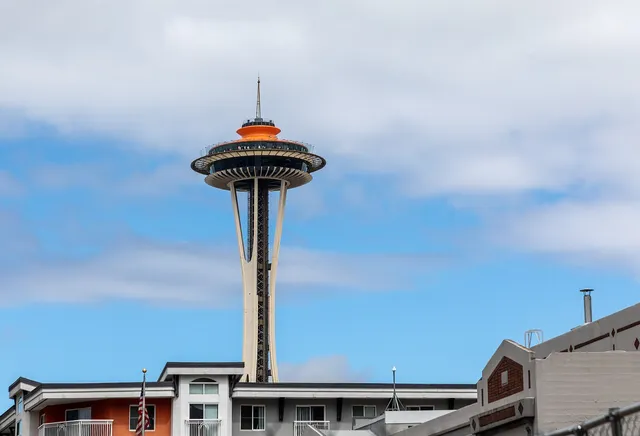
Space Needle
Built in about a year for the 1962 World's Fair, the Space Needle remains Seattle's fastest orientation lesson: 605 feet up, with Rainier in one window, the Olympics in another, and ferry wakes drawing lines across Elliott Bay below. The renovation finished in 2018 replaced the old railings with floor-to-ceiling glass and added a rotating glass floor, so the view now includes the structure under your feet. It is touristy and genuinely worth it.
Good to know · General admission runs $35-55 with plan-ahead pricing as of October 2026, booked at spaceneedle.com; entry is by timed ticket in 15-minute slots, and prices climb closer to the date. Hours shift by day of the week, so check the calendar when you book, and go an hour before sunset for day, dusk, and lights in one visit.
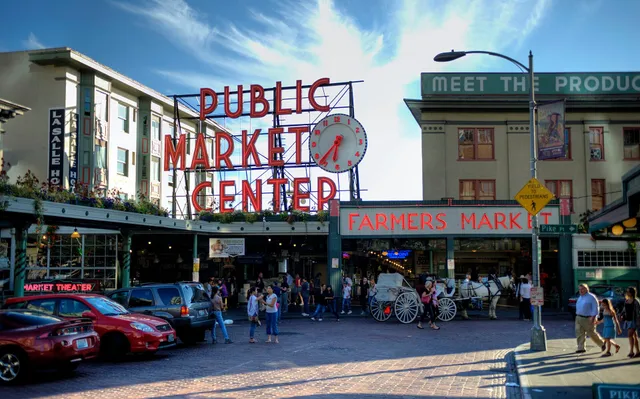
Pike Place Market
Open since August 17, 1907, Pike Place is one of the oldest continuously operating public farmers markets in the United States and still the city's pantry: fishmongers hurling salmon at the main counter, flower stalls by the armful, produce by the crate, and low-sunken levels below full of oddball shops. The original Starbucks opened here in 1971, and the 1912 Pike Place storefront has been pouring since 1977. Free to enter, best early, endlessly rewatchable.
Good to know · The market is open daily and stalls keep their own hours, most trading from mid-morning to late afternoon (the market posts them at pikeplacemarket.org). Go before 10 a.m. to beat the crush, watch the fish throwing near the main fish counter, and leave an hour for the lower levels and Post Alley.
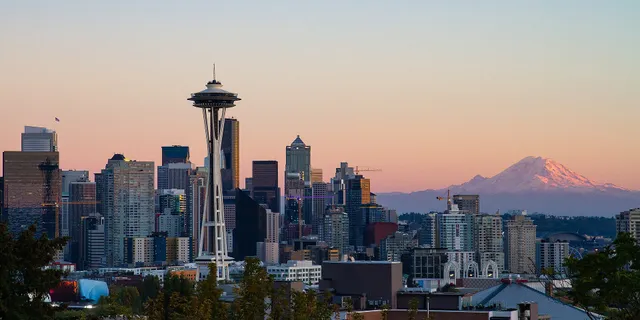
Kerry Park
One 1.26-acre lawn and railing on the south slope of Queen Anne Hill, given to the city in 1927, and the postcard view of Seattle: the skyline centered on the Space Needle, Elliott Bay below, and Mount Rainier in the background on clear days. Photographers line up along the rail at sunset, and on winter evenings the whole city shows up for it. There is nothing to do here except look, which is exactly the point.
Good to know · Seattle Parks opens it daily from 6 a.m. to 10 p.m., free of charge, with benches and a Doris Chase sculpture to frame your shot. It sits about a mile uphill from Seattle Center, a short bus or rideshare ride, and the walk back down afterward is the easy direction.
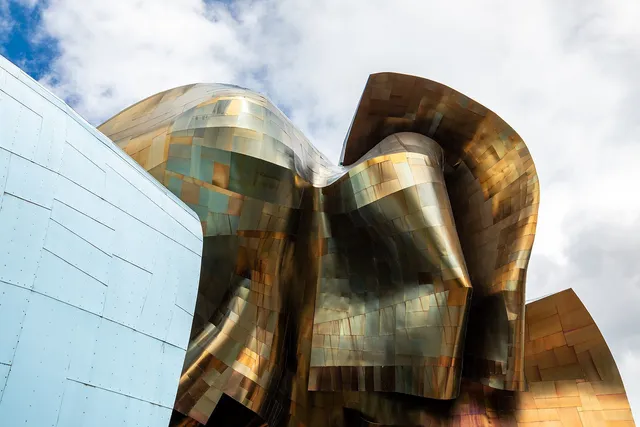
Museum of Pop Culture (MoPOP)
Paul Allen founded this museum in 2000 as the Experience Music Project, and Frank Gehry's molten building of colored steel, with the monorail passing clean through it, now holds galleries on science fiction, horror, fantasy, and video games, long-running rooms devoted to Nirvana and Pearl Jam, and the Sky Church, a cathedral-scale hall built around one of the world's largest indoor LED screens. It is the rare museum where teenagers drag their parents from room to room.
Good to know · Hours run 10 a.m. to about 5 p.m. on open days, though the schedule shifts week to week; admission is calendar-priced, so pick your date at mopop.org (as of October 2026, Washington residents save 15 percent with ID). It stands next to the Space Needle, so the two make one natural Seattle Center day.
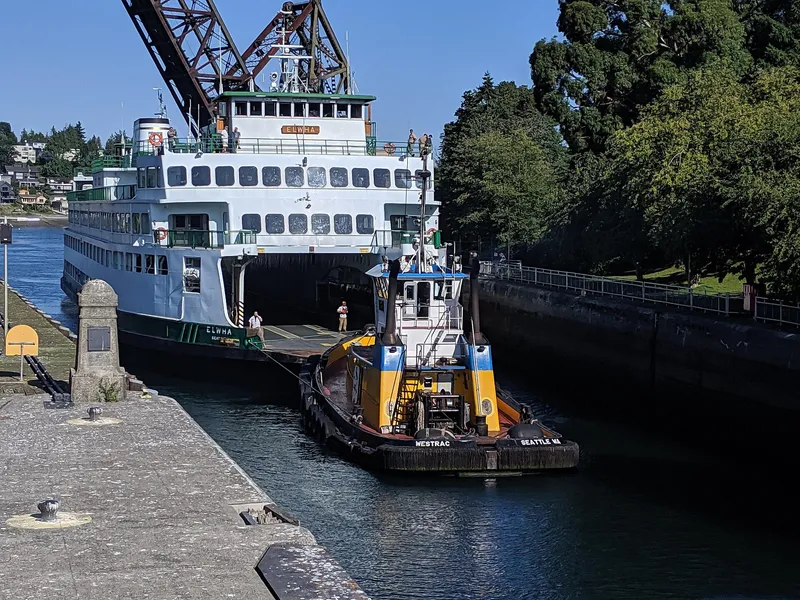
Ballard Locks (Hiram M. Chittenden Locks)
Finished in 1917, the Ballard Locks join the fresh water of Salmon Bay to the salt of Puget Sound and carry more boat traffic than any other lock in the United States, from fishing vessels to kayaks. Beside the spillway, a fish ladder with underwater viewing windows lets you watch Chinook, coho, and sockeye salmon work upstream in summer. The surrounding Carl S. English Jr. Botanical Gardens make it a proper park, and entry is free.
Good to know · Grounds are open daily with hours that stretch longer in summer, posted by the US Army Corps of Engineers, which operates the site; salmon run heaviest from midsummer into early autumn. Ballard is a 15-20 minute bus or rideshare ride northwest of downtown, and its brewery blocks pair naturally with the visit.
See it in motion
Some places earn a moving picture
Stills can't show how this place moves: the drift, the light show, the crowd flow. We picked a recent, high-quality walkthrough rather than a promotional cut.
Seattle Walking Tour: Pike Place Market to the Space Needle
CJ Travels · YouTube · plays on click
Embedded via YouTube's official player (privacy-enhanced mode). Video: Seattle Walking Tour: Pike Place Market to the Space Needle by CJ Travels. Not affiliated with Wide Open America; screened for quality and accuracy on 2026-10-15.
Seattle is the rare American city where the scenery and the city actually match. Downtown towers rise straight off Elliott Bay, ferries cut across the water all day, and on clear mornings the snow dome of Mount Rainier floats over the skyline like it was added in post. The pace suits first-time visitors: the core is compact, the light rail runs from the airport without a transfer, the street-level coffee is the best in the country, and summer days stay light past nine. Watch fish fly at a century-old market, ride a monorail through a museum, sail to an island for lunch, and finish at a railing where the whole city poses for its portrait. Give Seattle three or four days.
A Bit of History
Seattle was founded by American settlers in November 1851 at the mouth of the Duwamish River and named for Chief Seattle, the Duwamish and Suquamish leader whose people had lived on these shores for millennia. The town grew on timber: Douglas fir went out by sea to rebuild San Francisco, and the mills at the foot of Yesler Way made the first downtown rich enough to burn. The Great Seattle Fire of 1889 leveled the wooden business district, and the city rebuilt in brick and stone so fast that street levels rose a story in places; those buried first floors survive under Pioneer Square on guided underground tours.
Gold made it a city. On July 14, 1897, the steamship Portland docked carrying a famous ton of Klondike gold, and Seattle became the outfitting capital for the Alaska and Yukon stampedes. Few miners got rich, but the merchants selling boots, tents, and passage did, and their banks and shipping lines turned a lumber town into a Pacific port.
The twentieth century ran on Boeing, which grew from mail planes into the wartime bomber works and made the region’s fortunes rise and fall with aviation. The skyline’s icon arrived between those eras: the Space Needle was designed and built in barely a year for the 1962 Century 21 Exposition, a proper World’s Fair that left behind Seattle Center, the monorail, and a city comfortable calling itself modern. When Boeing’s contracts collapsed in the early 1970s, a real billboard asked the last person leaving to turn the lights off. Recovery came from software, Microsoft in the region and then Amazon downtown; by 2025 the city held roughly 785,000 residents, 18th in the country, with a metro above four million.
The soundtrack is local too. From 1918 to 1951, nearly two dozen jazz clubs ran along Jackson Street, giving early work to Ray Charles and Quincy Jones; Jimi Hendrix grew up here; and in the early 1990s the clubs around Capitol Hill and Belltown launched grunge, with Nirvana, Pearl Jam, Soundgarden, and Alice in Chains turning the rain into a worldwide sound. That is a lot of history for a city this young, and most of it is still visible within a day’s walk.
Culture & Daily Life
Start with the weather, because Seattle’s reputation needs correcting. The rain is real but seasonal: the great majority of the year’s precipitation falls between October and March, usually as a gray drizzle nobody bothers to unpack an umbrella for, while July and August are reliably dry, warm rather than hot, and light until after nine. Locals dress in layers and treat September as the insider’s month. Come in June for green parks and empty trails; come in late summer for the best sunshine odds.
Next, the coffee, which is not a joke here: the average neighborhood cafe outclasses what most big cities call good. Order a flat white or just a drip at any corner roaster and you are drinking local patriotism. The first Starbucks opened near Pike Place in 1971, and the storefront at 1912 Pike Place has been pouring since 1977; the queue there is a photo line more than a coffee line, so take the picture once and drink where locals do.
Seattle thinks in neighborhoods. Ballard is the old Scandinavian fishing district, now breweries and the locks; Fremont is the quirky one, full of public statuary; Capitol Hill holds the nightlife and much of the LGBTQ community; the Chinatown-International District keeps a century of Asian American history and the best dim sum; West Seattle sits across the water with its own beach-town rhythm. Downtown itself thins out in the evening.
Practicalities are standard American. Tip 18-22 percent at table-service restaurants, $1-2 a drink at bars, and 10-15 percent for delivery, with the full rundown at /guides/tipping-and-sales-tax/; posted menu prices gain sales tax at the register, so the bill lands near a tenth higher, and /tools/real-price-calculator/ does that arithmetic for you. Alcohol is 21-and-over with photo ID, checked without exception. Like most big West Coast cities, Seattle has visible street homelessness in parts of downtown; locals treat it as a civic fact, and visitors should walk with normal city awareness and keep car interiors empty of bags.
Nature & the Outdoors
Seattle’s setting does half the sightseeing. The city fills a narrow strip between Puget Sound, a saltwater arm of the Pacific, and Lake Washington, a freshwater lake the size of a small sea, and both stay in daily view. The Olympics line up across the Sound; Mount Rainier, a volcano with its own national park two to three hours away by road, appears on clear days like a rumor made solid.
In town, the outdoors is free and close. Discovery Park wraps bluffs, meadows, and a lighthouse around the old Fort Lawton grounds; Alki Beach gives West Seattle a proper saltwater strand with the skyline across the bay; the Burke-Gilman Trail runs a dozen paved miles out of Ballard and is the city’s favorite bike ride. Kayaks rent by the hour on Lake Union, where houseboats float and floatplanes land. Orcas pass through the Sound on their own schedule, so book a whale-watching tour rather than hoping for luck from shore.
One caution before you plan big trail days: US emergency care is not free for visitors, and an ER visit without insurance can cost hundreds to thousands of dollars, so confirm travel medical cover before you go; see /guides/health-insurance-safety/ for what to check.
Food & Drink
Seattle eats from the water first. Wild salmon is the essential plate, king, coho, and sockeye simply grilled, smoked over alder, or served cold on a bagel with cream cheese, and you are rarely more than a block from a version of it during the summer runs. Puget Sound oysters come small and briny by the dozen, Dungeness crab shows up cracked in season, and none of it is fancy here; it is harbor food. The city’s humbler signature is Seattle-style chicken teriyaki, a local institution of strip-mall counters that feeds much of the city for $12-16, alongside the pho and banh mi the Vietnamese community built into daily eating. Washington wine pours by the glass at prices that undercut California comparisons, and cider is a regional default.
Neighborhoods set the table. Pike Place Market is the morning move: produce, flowers, and a paper cone of fried fish to eat on the waterfront. The Chinatown-International District runs dim sum carts and noodle houses; Capitol Hill covers every budget from taco counters to tasting menus; Ballard’s breweries pour local beer with solid pub food, children and dogs welcome. For a cheap picnic, market fruit stalls, a bakery loaf, and a wedge of cheese beat most restaurant lunches; carry it to the waterfront benches or the grass at Victor Steinbrueck Park one block north. Coffee ends every meal; order the flat white and calibrate the rest of the country against it.
Budgeting runs close to other big West Coast cities: casual meals run $15-25, good dinners $40-70, and a flat white $4-7. Tipping is standard US practice, 18-22 percent for table service, $1-2 per drink, 10-15 percent for delivery, with the full guide at /guides/tipping-and-sales-tax/, and remember menu prices gain sales tax at the register; /tools/real-price-calculator/ totals a realistic bill for you.
Top Sights
Space Needle
Built in barely a year for the 1962 World’s Fair (construction finished that December, doors opened April 21, 1962), the Space Needle remains the fastest orientation lesson in Seattle. Elevators run to the observation level at 518 feet, with the spire reaching 605, and the renovation completed in 2018 swapped the old cage railings for floor-to-ceiling glass and added a rotating glass floor, so you watch the city slide beneath your feet. Rainier fills the southeast window, the Olympics line the west, and ferry wakes draw straight lines across Elliott Bay.
As of October 2026, general admission runs $35-55 with plan-ahead pricing that rises as slots fill, booked at spaceneedle.com; entry is by timed ticket in 15-minute windows, and discounts apply online for youth (ages 5-12) and seniors (65+). Hours move with the calendar (spaceneedle.com posts them week by week), so check before you go. Go an hour before sunset: you get the day view, the sunset, and the city lights in one ticket. The security line moves slowest at midday; the Chihuly Garden and Glass combo next door is the sensible bundle.
Pike Place Market
Open since August 17, 1907, Pike Place Market is one of the oldest continuously operating public farmers markets in the United States, and it is still a working food market before it is a spectacle: farmers’ stalls, buckets of flowers, and fishmongers at the main counter who throw whole salmon across the ice to cheering crowds. More than 20 million people a year come through, which tells you both its pull and its crowd pattern; before 10 a.m. it is a market, at noon it is a festival.
The lower levels hide the good strange stuff, small shops stepping down the hillside, plus the gum-covered wall in Post Alley that is exactly as gross as it sounds. The original Starbucks opened near the market in 1971; the little storefront at 1912 Pike Place has been pouring since 1977 and now trades on its queue as much as its coffee. Entry is free, stall hours vary (the market posts them at pikeplacemarket.org), and the smart route runs downhill through the market and out to the waterfront.
Kerry Park
Kerry Park is 1.26 acres of lawn and railing on the south slope of Queen Anne Hill, given to the city in 1927, and it produces the view you have seen a hundred times without knowing the address: the downtown skyline centered on the Space Needle, Elliott Bay beyond, and on clear days Mount Rainier floating behind everything. Seattle Parks opens it daily from 6 a.m. to 10 p.m., free, with a few benches and a steel sculpture by Doris Chase that photographers use as a frame.
There is nothing to do here but look, which is the point. Come in the last hour of daylight, when sunset turns the towers gold against the Olympics and blue hour switches the whole skyline on. Summer mornings are the quiet alternative, often clearer before the haze builds. The park sits about a mile uphill from Seattle Center, a short bus or rideshare ride, and the walk down afterward is the easy direction; pair it with dinner on Lower Queen Anne.
Museum of Pop Culture (MoPOP)
The Museum of Pop Culture is the fun one. Microsoft co-founder Paul Allen founded it in 2000 as the Experience Music Project, and Frank Gehry wrapped its 140,000 square feet in swooping panels of colored steel that read as a smashed guitar; the Seattle Center Monorail passes clean through the building, which shows how woven into the campus it is. Inside sit galleries on science fiction, horror cinema, fantasy, and video games, long-running rooms devoted to Nirvana and Pearl Jam, and the Sky Church, a vast hall built around one of the world’s largest indoor LED screens.
Hours run 10 a.m. to about 5 p.m. on open days, though the weekly schedule shifts; admission is calendar-priced, so pick your date at mopop.org before you go, as of October 2026, and note Washington residents save 15 percent with ID. Two to three hours is right, and it pairs naturally with the Space Needle next door. Teenagers actively drag parents here, a rare museum property.
Ballard Locks (Hiram M. Chittenden Locks)
The Hiram M. Chittenden Locks, universally just called the Ballard Locks, are working infrastructure built between 1911 and 1917 that joins the fresh water of Salmon Bay to the salt of Puget Sound, and they carry more boat traffic than any other lock in the United States. The procedure is the show: gates swing shut, the chamber drains toward the Sound, and a fishing boat, a sailboat, and a kayak share the ride down with a gull escort. More than a million visitors a year watch it, alongside the surrounding Carl S. English Jr. Botanical Gardens.
The summer reason is the fish ladder beside the spillway: stepped channels with underwater viewing windows where Chinook, coho, and sockeye salmon work upstream toward the lakes, heaviest from midsummer into early autumn. The site is operated by the US Army Corps of Engineers, with free entry and seasonal hours posted on its site (nws.usace.army.mil), so check before you go. Ballard’s brewery blocks are minutes away; fold them into one long afternoon.
Getting There & Around
Seattle-Tacoma International Airport (SEA) sits south of downtown, and the smart way in is the Link 1 Line light rail from the airport station to Westlake in the core, roughly 40 minutes with a flat adult fare of $3 and free riders 18 and under, as of October 2026; pay with an ORCA card or the Transit GO app (soundtransit.org). A taxi or rideshare costs several times the train fare.
Inside the city, work on foot and transit. Downtown and the waterfront are walkable, King County Metro buses cover the hills, and Link runs north to Capitol Hill and the U District. The Seattle Center Monorail crosses from Westlake Center to Seattle Center in about two minutes on trains that run about every ten minutes; it charges separately, and hours and fares sit at seattlemonorail.com. The Bainbridge Island ferry from Colman Dock crosses in 30-35 minutes, with walk-on fares collected only on the outbound sailing and valid as a round trip (riders 18 and under sail free), which makes the skyline-view cruise the best transit deal in town.
Rent a car only for mountain days: Rainier and Olympic national parks are each two to three hours away, and downtown hotel parking regularly costs $50 or more a night.
Where to Stay
Downtown along the Pike-Pine and Westlake corridors is the practical first-visit base: airport rail, the monorail, and Pike Place Market on foot, with the widest price range and the tradeoff of quieter evenings. Seattle Center and Lower Queen Anne put families within a five-minute walk of the Needle, MoPOP, and the monorail, usually at lower rates. Capitol Hill, or Ballard and Fremont, are the local-flavor picks: Capitol Hill has the nightlife and its own light rail station, Ballard has breweries and the locks, and both reach downtown by bus in 15-20 minutes. Waterfront rooms trade on the view and price accordingly; a block or two inland usually costs less for the same location.
Book early for July and August, when conventions and cruise sailings compress availability. And price hotels the American way: add sales tax and daily parking (often $50 or more) before comparing anything; /tools/real-price-calculator/ shows what the bill actually totals.
Sources & verification (15)
- https://www.spaceneedle.com/plan-your-visit
- https://www.mopop.org/visit
- https://www.seattle.gov/parks/find/parks/kerry-park
- https://en.wikipedia.org/wiki/Pike_Place_Market
- https://en.wikipedia.org/wiki/Space_Needle
- https://en.wikipedia.org/wiki/Kerry_Park_(Seattle)
- https://en.wikipedia.org/wiki/Museum_of_Pop_Culture
- https://en.wikipedia.org/wiki/Ballard_Locks
- https://en.wikipedia.org/wiki/Seattle
- https://en.wikipedia.org/wiki/Washington_State_Ferries
- https://en.wikipedia.org/wiki/Seattle%E2%80%93Bainbridge_ferry
- https://wsdot.wa.gov/travel/washington-state-ferries/tickets
- https://en.wikipedia.org/wiki/1_Line_(Sound_Transit)
- https://en.wikipedia.org/wiki/Seattle_Center_Monorail_Monorail
- https://en.wikipedia.org/wiki/Seattle_Center