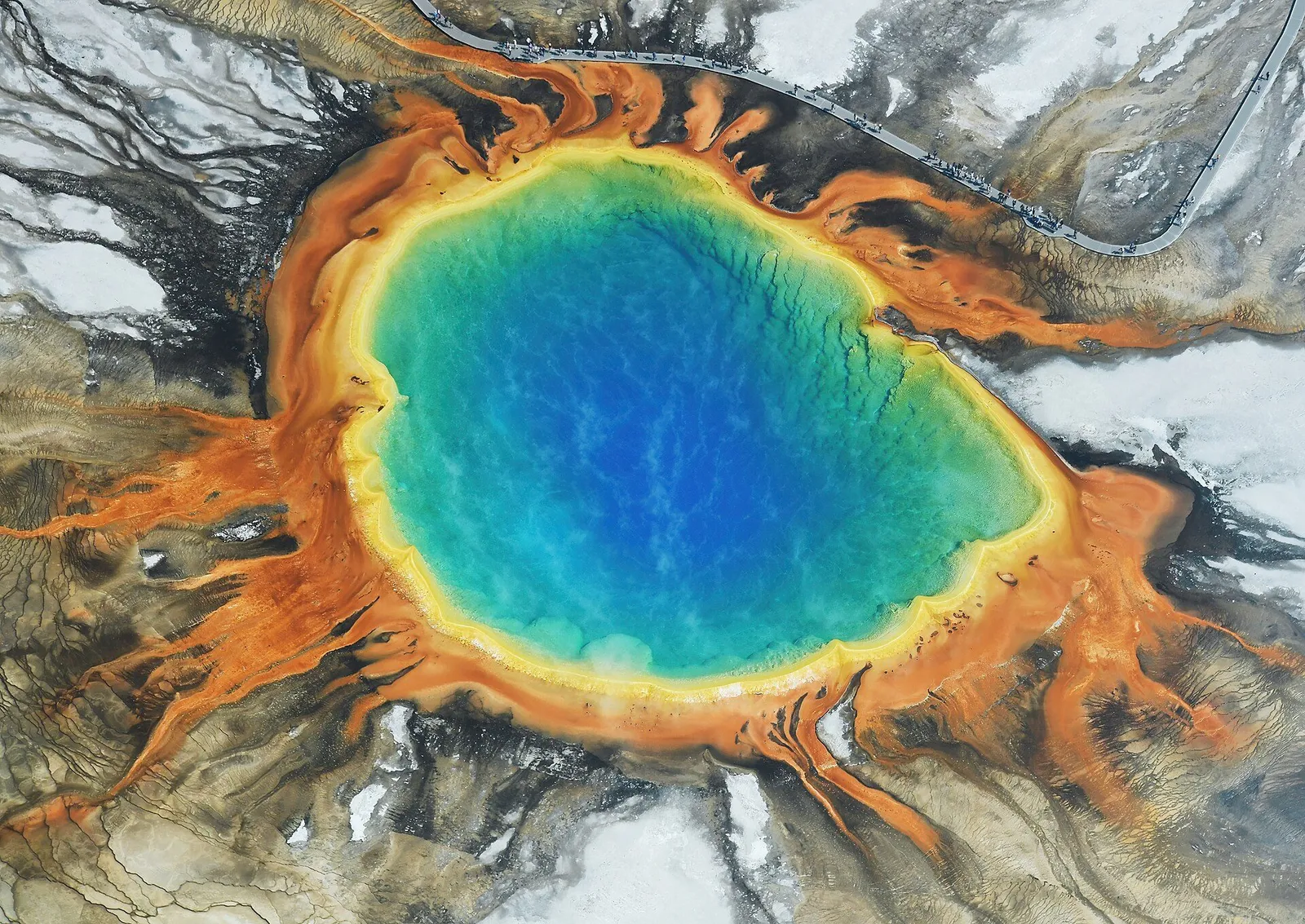
Yellowstone sits on top of a supervolcano, and the proof is everywhere: more than 10,000 hot springs, mudpots, and geysers, a river canyon painted in yellows and reds, and wildlife so abundant that its valleys double as the best safari in North America. The core loop links Old Faithful, Grand Prismatic Spring, the Grand Canyon of the Yellowstone, Lamar Valley, and Mammoth Hot Springs, and every one of them delivers what the postcard promises. The park suits travelers who want nature at full volume rather than city sightseeing, and who will trade cell coverage and fast drives for bison jams and dawn light. Give it three or four days based in West Yellowstone or a second gateway town, book park lodging up to a year ahead, and come between June and September, when every road is open.
Top sights at a glance
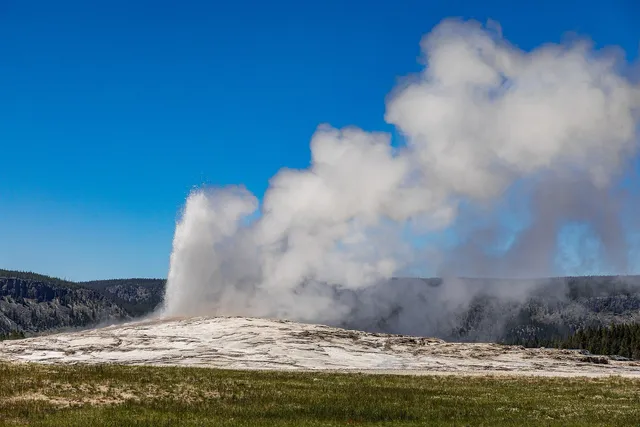
Old Faithful
Old Faithful is the geyser that made Yellowstone famous: a column of superheated water thrown 100 feet and higher on a schedule rangers can actually predict, usually every 60 to 110 minutes. It is one of nearly 500 geysers in the park and one of only six that rangers forecast, and it sits at the door of the Upper Geyser Basin, the densest geyser country on Earth, with miles of boardwalk past lesser-known but equally beautiful neighbors.
Good to know · Check the next predicted eruption at the Old Faithful Visitor Education Center, on boards at the lodges, or in the official NPS App, then claim a bench on the inn's porch 20 minutes early. Predictions pause when the visitor center closes in early winter and spring, so plan around the posted seasons. As of October 2026 the viewing area and boardwalks are free with park entry.
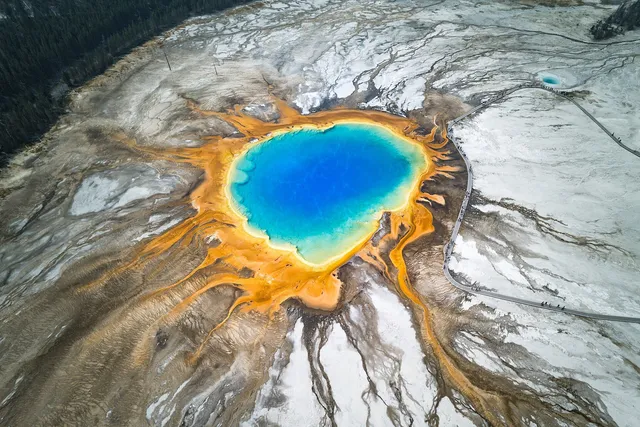
Grand Prismatic Spring
Grand Prismatic Spring is the largest hot spring in the United States and among the largest on Earth, a 200-plus-foot pool of impossible blue ringed by bands of orange, yellow, and green heat-loving microbes. From the Midway Geyser Basin boardwalk you cross the outflow channels steaming like a kettle; from the small overlook on the Fairy Falls trail you get the full rainbow from above, which is the photograph every postcard is honest about.
Good to know · Park at the Fairy Falls trailhead lot and walk about 20 minutes to the overlook; the Midway Geyser Basin lot fills before 9 a.m. in July and August. Morning steam hides the colors until the sun burns it off, so late morning to mid afternoon gives the best view. Stay on the boardwalk; the crust over boiling water is thinner than it looks.
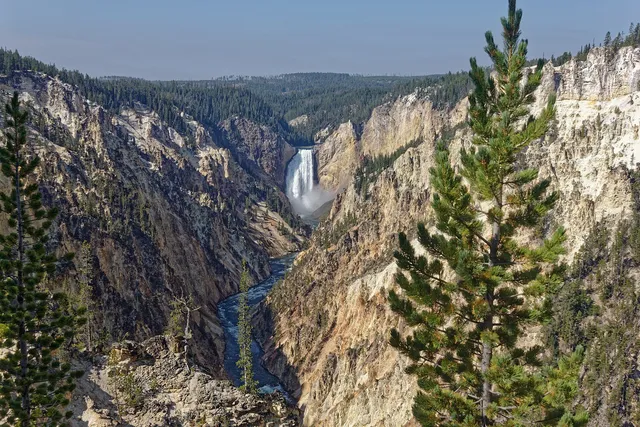
Grand Canyon of the Yellowstone
The Yellowstone River drops 308 feet at the Lower Falls, twice the height of Niagara, into a canyon of sulfur-yellow and rust-red rhyolite that gave the park its name. Artist Point is the classic frame, but the park runs both rims: the North Rim Drive adds the vertigo of the Brink of the Lower Falls, where you stand level with the river as it commits, and the South Rim Drive strings out quieter overlooks.
Good to know · Give the canyon two to three hours: Brink of the Lower Falls down-and-back is steep but short, and Artist Point is a level 10-minute walk from the parking lot. Check the park roads page at nps.gov the night before, since rim drives close to private cars during construction windows. Morning light favors Artist Point; afternoon favors the north side.
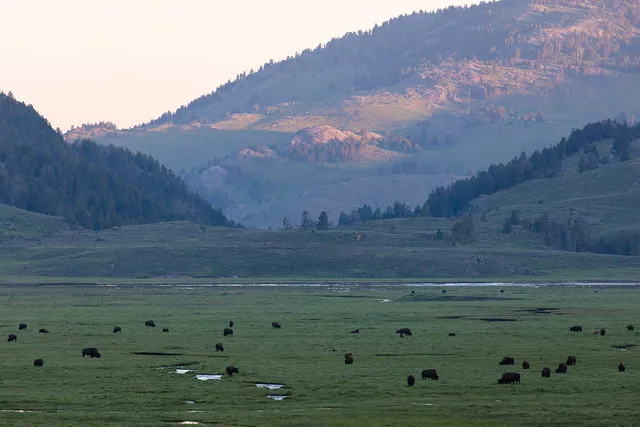
Lamar Valley
Lamar Valley, in the park's northeast, is the wildlife show people mean when they call Yellowstone the American Serengeti: herds of bison numbering in the hundreds, pronghorn on the ridges, and, since wolves were reintroduced in 1995, one of the most reliable places on the continent to watch a wild pack. The road follows the river through glacially wide grassland, so animals are visible at a distance rather than as roadside blurs.
Good to know · Be in the valley within an hour of sunrise or in the two hours before sunset; bring binoculars or a 300mm-plus lens, because the good sightings live far out in the meadows. The road from Tower Junction to the Northeast Entrance stays open all year. Follow the parked scopes, and keep at least 25 yards from bison and 100 yards from wolves and bears.
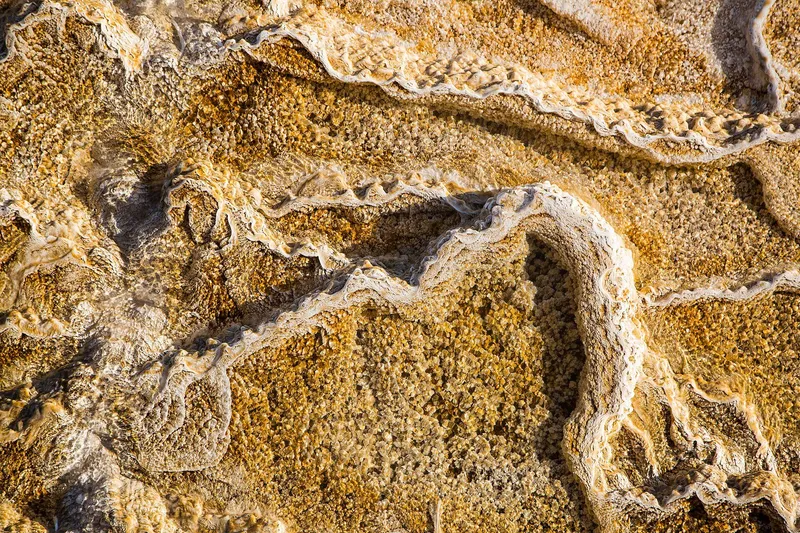
Mammoth Hot Springs
At the park's northwest corner, hot water rises through limestone and builds Mammoth Hot Springs, a hillside of stepped white-and-amber travertine terraces that visibly change month to month as channels move. Boardwalk stairs thread through the terraces, and below them sits Fort Yellowstone, the intact cavalry post from the park's army era, now park headquarters, where elk regularly graze the lawns like they hold the lease.
Good to know · The terraces sit 15 minutes inside the North Entrance, the one entrance reachable by road all year, so Mammoth anchors winter and shoulder-season trips. Walk the full lower-and-upper loop in about an hour and go early for hard light and empty boardwalks. Give grazing elk 25 yards; they are the park's most under-rated hazard in autumn.
See it in motion
Some places earn a moving picture
Stills can't show how this place moves: the drift, the light show, the crowd flow. We picked a recent, high-quality walkthrough rather than a promotional cut.
11 Must-See Stops in Yellowstone National Park
Chrissa Travels · YouTube · plays on click
Embedded via YouTube's official player (privacy-enhanced mode). Video: 11 Must-See Stops in Yellowstone National Park by Chrissa Travels. Not affiliated with Wide Open America; screened for quality and accuracy on 2026-10-15.
Yellowstone is where the American idea of wilderness was invented: the world’s first national park, set aside in 1872, and still the most complete nature show on the continent. A supervolcano breathes under the plateau, feeding more than 10,000 hot springs, mudpots, and geysers; the Yellowstone River has cut its own Grand Canyon through yellow rhyolite; and bison, wolves, and grizzly bears live here in numbers no other park in the lower 48 matches. Almost nothing in Yellowstone requires more than a short walk from the car, and almost nothing behaves like a zoo. This is a trip for travelers who want nature at full volume rather than city sightseeing: give it three or four days, drive the figure-eight Grand Loop slowly, and keep your distance from everything with fur.
A Bit of History
People were here long before the park was. Native nations have used the Yellowstone country for more than ten thousand years, crossing the plateau on trade routes and using the thermal waters, and today dozens of tribes are officially associated with the park’s lands. The American public learned of the region from the 1869-1871 expeditions of Cook, Folsom, the Washburn party, and the government surveys led by Ferdinand Hayden, whose reports of a place where rivers boiled and canyons were painted yellow read like fiction until the photographs of William Henry Jackson and Thomas Moran’s paintings arrived in Washington.
Congress did something genuinely new with the evidence: on March 1, 1872, President Ulysses S. Grant signed the act that withdrew more than two million acres from sale and settlement as “a public park or pleasuring-ground,” the world’s first national park and the template nearly every country has copied since. Early protection was shaky, with poachers and souvenir hunters stripping the terraces and the herds, so the US Army ran the park from 1886 to 1918 and built the stone-and-timber post you can still walk at Mammoth. The railroads arrived in the same era, building grand gateway hotels and running excursions that made Yellowstone mass tourism decades before the automobile, and by the time automobiles were finally admitted in 1915, the park’s hotels, roads, and ranger tradition were already in place. The National Park Service, created in 1916, inherited the job, the buildings, and the concessioner system.
Architecture became part of the show. Robert Reamer’s Old Faithful Inn, framed in lodgepole pine over the winter of 1903-1904, invented the rugged National Park Style that lodges across the West imitated. The park absorbed shocks after that: the great fires of 1988, which burned roughly a third of the park and whose snags and young lodgepoles you drive through today, and the 1995 reintroduction of gray wolves, which rebalanced the ecosystem and made Lamar Valley famous. UNESCO listed Yellowstone as a World Heritage Site in 1978, but the honest summary is simpler: it is the park that started it all, still working.
Culture & Daily Life
Yellowstone runs on park time, and the first cultural adjustment is the roads. The Grand Loop is a figure-eight of about 140 miles at a 45 mph limit, with average drive times of 30 to 60 minutes between the major junctions, and the traffic is wildlife. Bison jams are a civic institution: everyone stops, everyone waits, everyone photographs. Pull fully into designated pullouts, never stop in the lane, and treat a delayed arrival as the price of admission rather than a problem.
The second adjustment is the season. Five entrance stations and the loop roads are open to regular vehicles from mid-April into early November; the road between the North Entrance, Mammoth, and the Northeast Entrance stays open all year; and from November through April most of the park belongs to snowcoaches, guided snowmobiles, and skiers. Summer brings ranger programs, junior ranger booklets, and evening amphitheater talks that are better than most visitors expect and cost nothing, and the park newspaper you are handed at the entrance lists each day’s ranger walks, talks, and evening programs, with the free junior ranger booklet keeping children honest through long driving days.
Crowds follow a pattern you can schedule around: the park’s own guidance is to enter before 7 a.m. or after noon, and to hit the headline sights outside the 10 a.m. to 4 p.m. peak. Cell service is effectively absent inside the park, so download the official NPS App’s offline maps before you arrive and check the park roads page the night before each driving day. Two American constants apply to the villages’ restaurants: tipping runs 18 to 22 percent for table service, detailed in /guides/tipping-and-sales-tax/, and posted prices gain sales tax at the register, which /tools/real-price-calculator/ totals for you. Alcohol means 21 and over with photo ID.
Geology & Landscape
Everything you see in Yellowstone is the surface of a volcano. The caldera beneath the plateau drives a hydrothermal system with more than 10,000 features, including the world’s greatest concentration of geysers, plus hot springs, mudpots, and fumaroles that make the ground hiss like a kettle factory. The palette is chemistry: boiling blue at the center, then rings of orange, yellow, and green where heat-loving microbes carpet the runoff.
The landscape swings from geyser basins to the Yellowstone River’s own Grand Canyon, a 20-mile, thousand-foot-deep gorge of yellow and red rhyolite, to Yellowstone Lake at nearly 7,800 feet, to the glacially flattened northern grasslands where the wildlife concentrates. Elevations run from about 5,300 to more than 11,000 feet, so expect snow patches in June and cold August nights.
The rules are not decoration: ground near hot springs can be a thin crust over boiling water, more than 20 people have died in the springs, and swimming in thermal water is illegal, so stay on boardwalks. Keep at least 25 yards (23 m) from all wildlife, including bison and elk, and at least 100 yards (91 m) from bears, wolves, and cougars, as the park’s safety page requires. One practical note covers all of it: US emergency care is not free for visitors, and a rescue or ER visit without insurance can cost thousands of dollars, so confirm travel medical cover before your trip; see /guides/health-insurance-safety/.
Food & Drink
Eating inside Yellowstone is easier than its remoteness suggests, as long as you expect cafeteria competence rather than destination dining. Each developed area has a range: full dining rooms in the historic lodges, casual cafeterias and grills at Canyon Village and Old Faithful, general stores with grocery aisles, delis, and espresso, and snack stands at the major sights. Dinner in a lodge dining room runs roughly $30 to 55, counter-service meals $12 to 20, and a picnic built from a general store costs $10 to 15 a head, which is why most regulars keep a cooler in the trunk and why the village stores are busiest at breakfast.
Breakfast is the easiest meal to eat well: village coffee counters open early, and gateway-town motels throw in breakfast more often than not. Vegetarian options are standard on village menus now, but anyone with strict dietary needs should shop in Bozeman or Jackson before entering, because the in-park grocery selection is thin. Huckleberry, meanwhile, appears in everything from jam to milkshakes, and it is the souvenir that actually gets eaten.
Game meat anchors gateway-town menus: elk burgers and bison steaks in West Yellowstone, Gardiner, and Cody, usually for less than the same dish costs inside the park, and brewpubs in the same towns pour Montana and Wyoming beers under the usual 21-plus ID rules. Pack a picnic for Lamar Valley and the geyser basins, because the best meal of the day happens wherever the wolves are. Store food properly: never leave food or coolers unattended, and use bear boxes where provided, because ravens open zippers and bears learn fast. Tipping follows US norms, 18 to 22 percent at table service and $1 to 2 per drink at bars, detailed in /guides/tipping-and-sales-tax/, and remember menu prices gain tax at the register.
Top Sights
Old Faithful
Old Faithful erupts on a schedule, which is exactly why it endures: rangers currently predict eruptions for six Yellowstone geysers, and this is the famous one, throwing superheated water 100 feet and higher every 60 to 110 minutes. It is one of nearly 500 geysers in the park, and the visit is worth two hours, because Old Faithful anchors the Upper Geyser Basin, the densest geyser field on the planet, with miles of boardwalk past Castle, Grand, Daisy, and Riverside, each with posted predictions.
The ritual: check the next predicted time at the Old Faithful Visitor Education Center, on the boards at the lodges, or in the NPS App, as of October 2026; walk out 30 minutes early; watch from the benches, then continue into the basin while the crowds drain to their cars. Predictions pause when the visitor center is closed, typically early November to mid-December and mid-March to mid-April. Do not skip the 1903-04 Old Faithful Inn next door; its 65-foot lobby founded American park architecture.
Grand Prismatic Spring
Grand Prismatic is the photograph that sells Yellowstone, and it deserves the billing: the largest hot spring in the United States, more than 200 feet across, improbably blue at the center and ringed by concentric rainbow bands of heat-loving microbes. You should see it both ways. From the Midway Geyser Basin boardwalk you cross the spring’s steaming outflow with the colors glowing through the vapor; from the Grand Prismatic Overlook, a 20-minute walk on the Fairy Falls trail, the whole rainbow spreads out below you, the photograph every postcard is honest about.
The trailhead lot is often full by mid-morning in July and August, so arrive early or after 4 p.m. On cold mornings steam fogs the whole spring; a warm late morning with light wind gives the cleanest view. The boardwalk rules matter most here: the outflow runs near boiling and the crust beyond the boards is fragile. One loop, both viewpoints, about 90 minutes.
Grand Canyon of the Yellowstone
The Yellowstone River’s canyon is the park’s most under-scheduled sight, because “see the falls” undersells a 20-mile, thousand-foot-deep gorge of yellow and red rock that gave the park its name. The centerpiece is the Lower Falls at 308 feet, twice the height of Niagara, and Artist Point is the single most reliable postcard in Wyoming: falls framed dead center, morning light on the walls, ravens below the rim.
North Rim Drive connects three viewpoints and the Brink of the Lower Falls trail, a steep 0.7-mile round trip that ends level with the river on a platform above the drop, the loudest 15 minutes in the park. South Rim Drive holds Artist Point plus overlooks toward Upper Falls, the smaller 109-foot drop above the canyon’s head. Check the park roads page first, as sections close to private cars in construction seasons. Allow two to three hours with the Brink walk; morning light favors Artist Point.
Lamar Valley
Lamar Valley is why you set an alarm in Yellowstone. The broad glacial valley in the park’s northeast corner holds the park’s largest bison herds, strong pronghorn and elk populations, and, since wolves returned in 1995, one of the best places in the world to watch a wild pack work a morning. Grizzly bears use the slopes in spring, and a slow dawn drive here outperforms any other wildlife hour in the American Rockies.
Arrive within an hour of sunrise or in the two hours before sunset, when animals move and light is low. Bring binoculars or a telephoto lens of 300mm or longer, because the meaningful sightings happen hundreds of yards out in the meadow, and the cluster of parked spotting scopes is your best real-time tip sheet: stop where the optics point, park fully off the pavement, and the wolf-watchers often share their glass. The distances are law, not advice: 25 yards from bison and elk, 100 yards from wolves and bears. The Northeast Entrance road through the valley stays open all year.
Mammoth Hot Springs
Mammoth is Yellowstone’s strange appendix: a hillside of travertine terraces at the park’s far northwest, where hot water rising through limestone deposits carbonate rock fast enough that the terraces visibly change between visits, channels diverting, colors shifting from bone white to rust and grey. The boardwalk system stairs up through the lower and upper terraces, past features with Victorian names like Minerva Terrace, and the geology moves fast enough to feel like construction rather than scenery.
Below the terraces sits Fort Yellowstone, the preserved administrative post from the army era between 1886 and 1918, its parade ground and officers’ row now park headquarters, a visitor center, and the nicest grass the local elk herd ever naps on. Frontier military architecture and actively growing geology within a five-minute walk make it the park’s best short stop. Mammoth sits 15 minutes inside the North Entrance at Gardiner, on the only road open to regular vehicles all year, so it anchors winter and shoulder-season visits. Allow an hour for the full terrace loop, go early for empty boardwalks, and give the lawn elk their 25 yards: autumn rutting bulls are the park’s most under-estimated hazard.
Getting There & Around
Most international visitors fly into Bozeman, Montana, about 90 minutes from the West Entrance, or into Jackson, Wyoming, inside Grand Teton National Park to the south; Cody and Idaho Falls are the other year-round choices. Rent a car: the park has no public transportation and the five entrances are hours apart, so open-jaw routes save real time.
The park’s own averages run about 30 to 45 minutes from the West Entrance to Old Faithful and 35 minutes from Lake Village to Canyon; the loop easily eats a day once wildlife stops traffic. Check the park roads page at nps.gov each evening; the 45 mph limit is enforced.
Entrance fees as of October 2026: a private vehicle pays $35 for seven consecutive days at Yellowstone, and the same again at Grand Teton, because the South Entrance road crosses Grand Teton and each park charges its own fee; there are no vehicle reservations or timed entry. Non-US residents aged 16 and over pay an extra $100 per person unless they hold an annual pass, and for most international trips the sensible choice is the $250 Non-Resident Annual Pass, covering entrance and surcharges for a full vehicle for 12 months. The $80 America the Beautiful pass is sold only to US residents; the full arithmetic is in /guides/national-parks-guide/.
Where to Stay
Inside the park, lodging clusters in villages: Old Faithful for the geysers at dawn, Canyon for a central base, Lake for the shore, Grant for the south, and Mammoth for the north, all bookable through the park concessioner at yellowstonenationalparklodges.com. Lodges and cabin blocks sell out as much as a year ahead for July and August, so reserve the day flights are fixed.
Gateway towns are the value play. West Yellowstone sits 30 to 45 minutes from Old Faithful with the widest choice of motels; Gardiner anchors the year-round north road and Lamar Valley; Cody adds a fun town on the east side; and Jackson pairs Yellowstone with Grand Teton on one trip, the route laid out in /itineraries/yellowstone-tetons-itinerary/.
Campers have 11 campgrounds with more than 2,000 sites, nearly all reservable on a rolling six-month window through recreation.gov and the concessioner, from $20 tent sites at Slough Creek to $45-plus at Canyon; Fishing Bridge is the hook-up RV park, hard-sided only. In winter, options collapse to the Mammoth area and snow-coach trips from West Yellowstone and Gardiner.
Sources & verification (12)
- https://www.nps.gov/yell/planyourvisit/fees.htm
- https://www.nps.gov/aboutus/nonresident-fees.htm
- https://www.nps.gov/grte/planyourvisit/fees.htm
- https://www.nps.gov/yell/planyourvisit/seasons.htm
- https://www.nps.gov/yell/planyourvisit/directions.htm
- https://www.nps.gov/yell/planyourvisit/safety.htm
- https://www.nps.gov/yell/planyourvisit/campgrounds.htm
- https://www.nps.gov/yell/learn/nature/old-faithful-geyser.htm
- https://www.nps.gov/yell/learn/nature/hydrothermal-systems.htm
- https://www.yellowstonenationalparklodges.com/
- https://www.recreation.gov/camping/campgrounds/259310
- https://en.wikipedia.org/wiki/History_of_wolves_in_Yellowstone