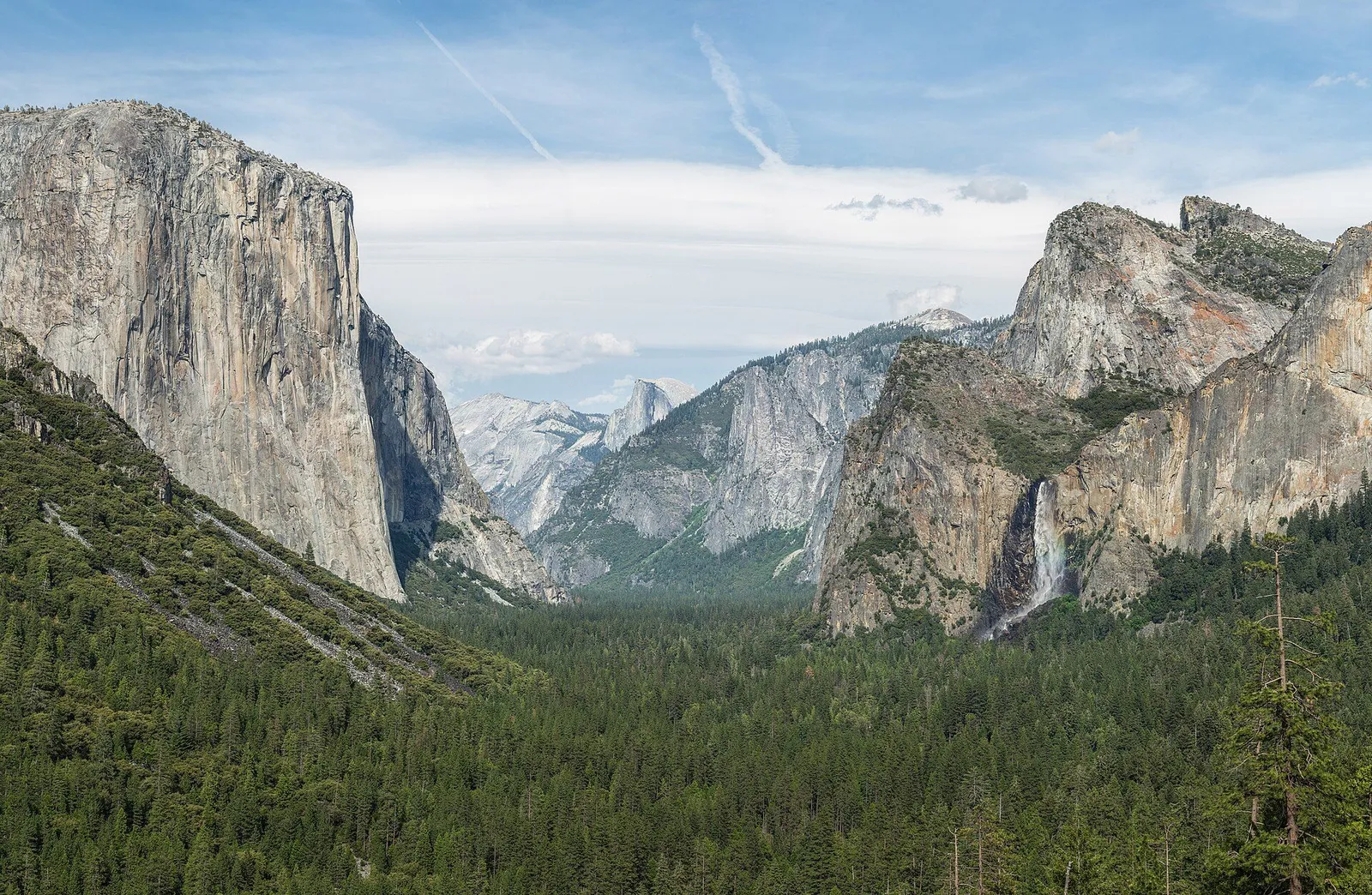
Yosemite is the Sierra Nevada's greatest stage: a glacier-carved valley where 3,000-foot granite walls, a 2,425-foot waterfall, and the rounded crown of Half Dome line up within a few miles of paved paths. First-timers usually center on Yosemite Valley, riding the free shuttle to El Capitan meadows, the base of Yosemite Falls, and misty trailheads, then add the giant sequoias of Mariposa Grove and the panorama from Glacier Point. As of October 2026 entry needs no timed reservation, just a $35 vehicle pass, though Half Dome's cables stay permit-only through a recreation.gov lottery. The park suits reasonably fit travelers who like scenery at walking pace, and rewards two or three days based in the valley or a Highway 140 gateway town.
Top sights at a glance
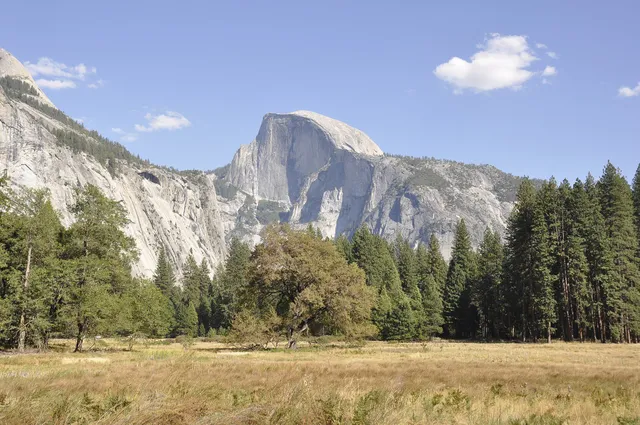
Yosemite Valley
Yosemite Valley is the park's seven-mile centerpiece, a glacier-carved floor at about 4,000 feet ringed by 3,000-foot granite walls, with the Merced River threading through meadows beneath El Capitan, Cathedral Rocks, and Half Dome. Nearly everything a first-time visitor wants sits here: the classic Tunnel View overlook, Cook's Meadow and Sentinel Bridge reflections, sandy river beaches in summer, and the free shuttle that strings it together without a car.
Good to know · As of October 2026 there is no entry reservation, so the valley floor parking lots fill by mid-morning in season; arrive before 9 a.m. or after 5 p.m. Ride the free valley shuttle (roughly 7 a.m. to 10 p.m.) or rent bikes at the lodge area in summer, since the valley's paved loop paths were built for wheels. Start at Tunnel View on Wawona Road for the photograph, then work east stop by stop.
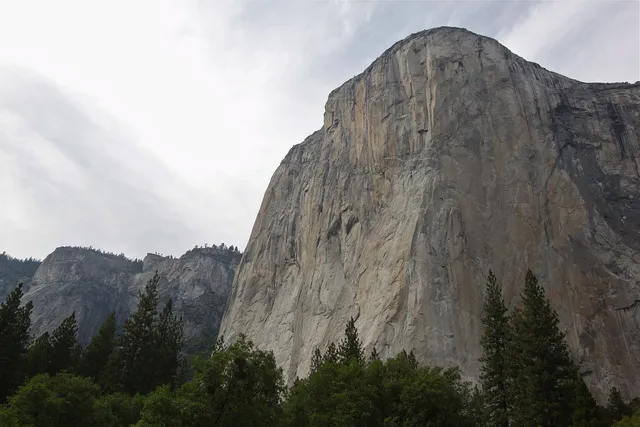
El Capitan
El Capitan is the largest exposed granite monolith on Earth, a single uninterrupted 3,000-foot wall of stone that was long considered unclimbable and now anchors the sport of big-wall climbing. From El Capitan Meadow, binoculars pick out climbers living on the wall for days at a time on rope-hung camps; September and October bring the year's best climbing weather and the most parties on the rock. Come at dawn when the wall glows pink and the meadow is silent.
Good to know · Park at the El Capitan picnic area pullout along Northside Drive and walk into the meadow; Rangers and volunteers run telescope programs here in season, listed in the park's daily program calendar. Give it an unhurried hour, and never approach the Merced River's steep banks nearby. No trail climbs El Cap from the valley in a day; the honest way to the summit is the long El Capitan Trail from Tamarack Flat, an overnight proposition.
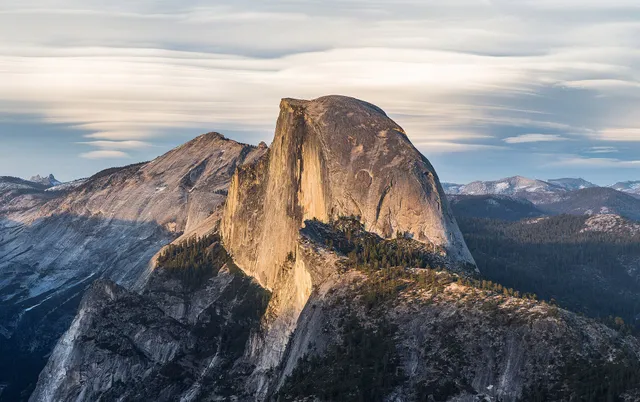
Half Dome
Half Dome is the park's signature silhouette, a granite dome whose summit sits at 8,839 feet and whose bare shoulder is scaled each summer on a pair of steel cables bolted into the rock. The full day hike from the valley floor runs 14 to 16 miles round trip with roughly 4,800 feet of gain, 10 to 12 hours for most hikers, and it is the most sought-after permit in the American park system.
Good to know · A permit is required whenever the cables are up, typically the Friday before Memorial Day through mid-October, and permits come only through recreation.gov lotteries: a preseason lottery applied for throughout March (results mid-April) and a daily lottery entered two days ahead, each with a $10 application fee plus $10 per hiker if awarded. Apply the March your trip is booked, and keep the daily lottery as plan B. If you miss out, view the dome from Glacier Point or Sentinel Bridge instead.
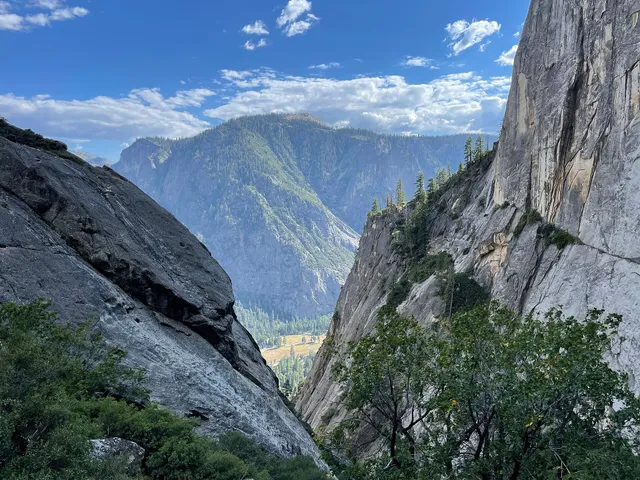
Yosemite Falls
Yosemite Falls drops 2,425 feet in three tiers, the upper fall alone falling 1,430 feet, making it one of the tallest waterfalls in North America. It roars from November through July with peak flow in May, then thins to a trickle or dries out entirely by late summer, so timing matters more here than anywhere else in the park. The one-mile loop to the base of the lower fall is paved and partly wheelchair accessible, and in cold winters an ice cone builds at its base.
Good to know · Walk the lower-fall loop from shuttle stops near Yosemite Valley Lodge; it takes 30 minutes and delivers the spray-level view. Peak flow is May, when the loop doubles as a shower. The hike to the top of the upper fall is a strenuous roughly seven-mile round trip climbing about 2,700 feet, best started at dawn in warm months; carry double the water you think you need.
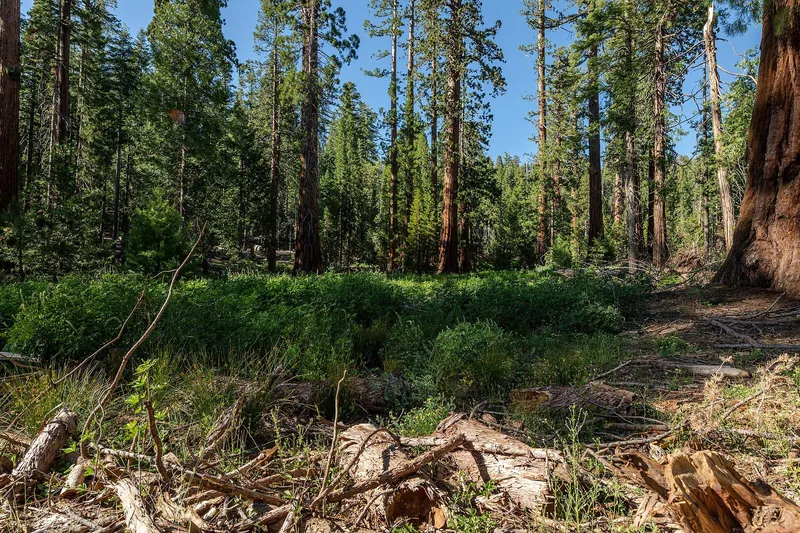
Mariposa Grove
Mariposa Grove, near the South Entrance on Highway 41, holds about 500 mature giant sequoias, the largest trees on Earth by volume, including the Grizzly Giant, estimated around 3,000 years old, and the walk-through California Tunnel Tree. Restored and replumbed in 2018 to move parking two miles downhill, the grove now opens onto a quiet network of trails, and it survived the 2022 Washburn Fire with quick firefighting and a bit of luck.
Good to know · As of October 2026 the grove road is closed to private vehicles (disability placards excepted); everyone else parks at the Welcome Plaza and rides the free shuttle, which runs roughly late April through November. Off-season you can walk the two miles up the road each way. Do the two-mile Grizzly Giant loop, allow half a day from the valley (about an hour's drive each way), and stay on trails; sequoia roots are shallow and fragile.
Every serious landscape on Earth has a rival that its admirers claim it beats, and Yosemite is the one where the argument usually stops. A glacier carved a valley seven miles long and set 3,000-foot granite walls around it, then hung waterfalls off the rims, and the result reads less like scenery than architecture: El Capitan on the left, Half Dome at the head of the valley, Yosemite Falls dropping the height of three Eiffel Towers a short walk from the parking. Around four million people a year come to look, which is the catch, and the art of a good visit is timing: early starts, the free shuttle, and a night or two inside the granite instead of a day trip racing the sun. This is a walking park, not a driving park, and it rewards travelers who treat it that way.
A Bit of History
People have lived in the Yosemite region for thousands of years; the Ahwahneechee, a Miwok and Paiute community, inhabited the valley itself when a state-sponsored militia, the Mariposa Battalion, marched in during 1851 in the violence of the Gold Rush era. A battalion surgeon, Lafayette Bunnell, gave the valley its name, badly mishandling the Ahwahneechee word the battalion had taken it from, and the survivors were driven out and later allowed to return in part. Tourism began almost at once: James Hutchings ran the first hotel in 1856, and the drawings and photographs that reached San Francisco did the rest.
What happened next made Yosemite a hinge of world history. In 1864, in the middle of the Civil War, President Abraham Lincoln signed the Yosemite Grant, ceding the valley and the Mariposa Grove to California as protected public land, the first time a national government had set aside scenery purely for preservation. John Muir arrived in 1868 and turned his love of the Sierra’s granite into writing that moved presidents; his 1903 camp-out with Theodore Roosevelt above Glacier Point effectively launched American conservation, and the modern national park idea followed. Yosemite became a national park on October 1, 1890, and the new National Park Service took over in 1916 with the valley as its crown exhibit.
The twentieth century kept writing the story. Ansel Adams made the park his darkroom subject; the golden age of big-wall climbing started on El Capitan in 1958; and UNESCO listed the park as a World Heritage Site in 1984. Fire is the recurring modern test, from the 2018 Ferguson Fire to the 2022 Washburn Fire that threatened Mariposa Grove to the 2024 Royal Fire near Glacier Point Road, each closing pieces of the park in its season. The grove survived, the road reopened, and the rule for visitors is simple: check the park’s current-conditions page before you commit to an itinerary, because in the Sierra the calendar and the fire map can change in the same week.
Culture & Daily Life
Yosemite Valley runs on a rhythm you should learn in your first hour. The 2024 experiment with peak-hours entry reservations and its much-reduced 2025 successor are both gone: as of October 2026 there is no timed reservation to enter Yosemite at any time of year, which means the crowds that reservations smoothed out are managed the old way, by arriving early. On summer days the valley’s day-use lots fill by mid-morning, and by afternoon the entrance queues can stretch for miles; the locals’ pattern is to be through the gate by 8 a.m., park once, and ride the free shuttle, which circles the valley roughly 7 a.m. to 10 p.m. with stops at every trailhead that matters.
The valley is also a working village and a world climbing capital, and both are worth watching. The Village complex holds the main store, a visitor center, and the Yosemite Museum, whose Indian Cultural Exhibit presents the ongoing presence of the Ahwahneechee’s descendants, the Southern Sierra Miwuk Nation, rather than a vanished people. At El Capitan Meadow, the telescopes and lawn chairs belong to the climbing watchers, a friendly subculture happy to let you look at parties 2,000 feet up the wall. Ranger walks, campfire talks, and evening programs are listed in the park newspaper handed out at the entrance and cost nothing; they are the best free hour in the valley.
The American constants apply. Tipping runs 18 to 22 percent at the valley’s table-service restaurants and $1 to 2 per drink at bars, detailed in /guides/tipping-and-sales-tax/, and posted prices gain California sales tax at the register, which /tools/real-price-calculator/ totals honestly. Cell service in the valley is patchy and disappears on the high roads, so download the official NPS App’s offline maps before you arrive. Alcohol is 21 and over with photo ID, everywhere in the park.
Geology & Landscape
Yosemite is a granite story. The valley’s walls crystallized from molten rock miles underground during the age of dinosaurs, were lifted with the Sierra Nevada, and then spent the last few million years being shaped by glaciers that quarried the earlier river canyon into a U-shaped trough; the ice left about 10,000 years ago, young enough that the landscape still shows the tool marks, from polished domes to boulders dumped in the meadows. Hanging valleys where smaller glaciers met the deep one explain the waterfalls: streams enter the main valley hundreds of feet above its floor, which is why Yosemite Falls drops 2,425 feet.
Two facts make the Sierra’s temperament your problem. First, elevation: the valley floor sits around 4,000 feet but the park climbs past 13,000, and the high country’s snow lingers into summer; Tioga Road, the only road across it, typically opens to cars between late May and June and closes with November snow, opening May 15 in 2026. Second, fire is part of the ecology and the operating reality: sequoias need it, and some years it closes roads and groves, as October 2026’s Dome Fire near Wawona was doing as this page updated, so the current-conditions page is a pre-trip ritual.
The risk that most often catches visitors out is ordinary: heat and dehydration on valley trails in July and August, or slips on wet granite near waterfalls. US emergency care is not free for visitors, and a helicopter evacuation bill without insurance can reach five figures, so confirm travel medical cover before you go; see /guides/health-insurance-safety/.
Food & Drink
Eating in Yosemite is a solved problem if you plan for cafeterias rather than cuisine. The valley runs on three tiers: the lodge and hotel dining rooms, where dinner runs roughly $30 to 60 and breakfast before a hike is the best slot; fast-casual counters at the Village, the lodge area, and Curry Village, where pizza, burgers, and sandwiches run $12 to 20; and the Village Store, a real if expensive grocery whose deli makes the park’s best lunch. That third option is the local technique: buy supplies in the morning, picnic at Sentinel Bridge or El Capitan Meadow at sunset, and skip the 6 p.m. dinner lines entirely.
Stock up before you arrive. Groceries inside the park are priced for captive audiences and thin on specialty ranges, so travelers with dietary needs should shop in Merced, Fresno, or the gateway towns of Oakhurst and Mariposa. Those gateways also hold the best eating within reach of the park: Mariposa and Oakhurst on Highway 41 have proper restaurants and brewpubs, Groveland on Highway 120 has historic tavern dining, and El Portal on Highway 140 keeps a handful of low-key spots 20 minutes from the valley. Gateway portions run larger and prices 20 percent lower than in-park, and breakfast in town before an early gate entry is the locals’ pattern.
Alcohol is 21 and over with photo ID, and the lodge bars close early by city standards; the park is an early-to-bed place. Tipping follows US norms, 18 to 22 percent at table service and $1 to 2 per drink, detailed in /guides/tipping-and-sales-tax/, and California prices gain sales tax at the register. Carry a refillable bottle year-round: the valley runs water stations, and the combination of altitude, dry air, and hiking dehydrates people faster than they notice.
Top Sights
Yosemite Valley
The valley is the park’s engine room and the right place to spend your first half day. Start at Tunnel View on Wawona Road, where the whole cast lines up in one frame: El Capitan left, Bridalveil Fall right, Half Dome center stage, the composition Ansel Adams worked. On the floor, the sights chain together on foot or by shuttle: Cook’s Meadow’s boardwalks for Half Dome reflections, Sentinel Bridge for the water-level view, El Capitan Meadow for the wall, and sandy bends of the Merced River for a late-summer swim.
Two habits make the valley work. Park once at the Village or day-use lots and move by shuttle or bike; the paved loop is flat and partly car-free, and bike rentals run at the lodge area in warm months. And go early or late: mid-day belongs to the tour buses, while 7 a.m. belongs to deer in the mist and 7 p.m. to alpenglow. None of it needs a permit or a tour, just a park pass and sensible shoes.
El Capitan
El Capitan is the wall that changed climbing. A single crescent of granite about 3,000 feet from base to summit, it was attempted and ridiculed for decades until Warren Harding’s team completed the Nose in 1958 after 47 days on the rock; today’s elite climb it in hours, the Dawn Wall’s 2017 first ascent and Alex Honnold’s 2018 free solo, an Oscar-winning film subject, made it mainstream news. You do not need to climb it to feel any of this: from El Capitan Meadow the scale reads honestly, and binoculars reveal tiny rope-hung camps and the climbers sleeping on them.
The practical version is easy: park at the picnic-area pullout on Northside Drive, walk into the meadow, and give it an hour, longer if volunteer telescope programs are running. The wall photographs best in early light. Cathedral Rocks and Bridalveil Fall, just up-canyon, belong to the same stop. The summit is an overnight via the El Capitan Trail, outside a first visit’s scope.
Half Dome
Half Dome is the hike people plan trips around, and the permit is the planning. The route from Happy Isles climbs past Vernal and Nevada Falls into Little Yosemite Valley, then up the shoulder to the cables, two steel pipes bolted into the dome’s bare back, which you ascend hand over hand with a 400-foot drop beside you. The round trip runs 14 to 16 miles and about 4,800 feet of gain; most hikers take 10 to 12 hours, and the cables go up the Friday before Memorial Day and come down after the second Monday of October.
Permits are the story as of October 2026: a permit is required to go up the cables whenever they are up, and recreation.gov runs two lotteries, a preseason lottery applied for throughout March with results in mid-April, and a daily lottery entered two days before your date, each charging a $10 application fee plus $10 per hiker awarded. Apply in March the year of your trip, up to six people per application, and set a daily-lottery alarm as backup. If you lose both, the view from Glacier Point or Sentinel Bridge is fair consolation.
Yosemite Falls
Yosemite Falls is the tallest waterfall in the park and among the tallest in North America: 2,425 feet total, split into a 1,430-foot upper fall, 675 feet of cascades, and a 320-foot lower fall. The lower fall is the family classic, reached on a paved one-mile loop from the shuttle stops near the valley lodge, and at peak flow in May the viewing plaza takes a legitimate soaking; by August the whole thing is often dry, a bare streak of polish on the cliff. In cold winters, spray builds an ice cone hundreds of feet tall at the base.
The summit is the ambitious option: the Upper Yosemite Fall Trail climbs about 2,700 feet in roughly 3.5 miles, a strenuous seven-mile round trip best begun at dawn, with the payoff of looking down the drop and across to Half Dome. Either way, check the season before you promise anyone a waterfall: the falls flow roughly November through July, peak in May, and go quiet by late summer, which is the single best argument for a May or June visit.
Mariposa Grove
The biggest living things on Earth grow an hour’s drive from the valley. Mariposa Grove, at the South Entrance on Highway 41 past Oakhurst and the historic Wawona area, holds about 500 mature giant sequoias, cousins of the coast redwood that trade height for sheer volume. The stars are the Grizzly Giant, a squat 3,000-year-old patriarch with a fire-scarred base, and the California Tunnel Tree, cut for carriages in 1895 and walkable today; the 2018 restoration removed parking from inside the grove and returned it to forest quiet.
Logistics decide your day here. The grove road is closed to private vehicles (disability placards excepted) and the free shuttle from the Welcome Plaza runs roughly late April through November; off-season, the two-mile road walk each way is your warm-up. From the grove, the paved Big Trees Loop takes 30 minutes and the Grizzly Giant loop two hours, and both are busy by late morning, so ride an early shuttle. Give the grove half a day from the valley, and keep to the trails: sequoia roots spread wide and shallow, and a careless boot damages the meal ticket of a 3,000-year-old tree.
Getting There & Around
Most international visitors fly into San Francisco, Oakland, or San Jose and drive about four hours, or into Fresno Yosemite International, the closest major airport at 2.5 hours from the valley. Four roads enter: Highway 140 from Merced through El Portal (the lowest, all-year route and the safest in snow), Highway 120 from the Bay Area side, Highway 41 from Fresno, and seasonal Tioga Road over the Sierra from the east, typically closed November to late May. Car-free is genuinely possible: YARTS buses run year-round from Merced (reached by Amtrak or Greyhound) up Highway 140 into the valley, with summer-only routes from Fresno, Mammoth Lakes, and the 120 corridor.
Entrance as of October 2026: $35 per vehicle, valid seven days, no reservation needed at any time of year, and no cash accepted at entrance stations. Non-US residents aged 16 and over pay an extra $100 per person unless they hold an annual pass, and for most international trips the sensible buy is the $250 Non-Resident Annual Pass, covering a full vehicle for 12 months; the $80 America the Beautiful pass is sold only to US residents, with the arithmetic in /guides/national-parks-guide/. From November through April, carry tire chains even in a 4WD rental, by law when controls are posted; rental companies rarely provide them.
Where to Stay
Sleeping inside the park is the experience, and the booking window is the trick: the concessioner at travelyosemite.com opens reservations 366 days ahead, and summer valley rooms are claimed on that schedule, though cancellations churn constantly, so re-check if you miss the first wave. In the valley, the choice is between the Yosemite Valley Lodge area near the falls (year-round, family-practical), Curry Village’s cabins and tent cabins (seasonal, cheapest in-park roof), and the grand 1927 Ahwahnee; several smaller historic properties elsewhere in the park have had staggered closures in recent years, so verify what is open before planning around them. Campgrounds like Upper Pines and Wawona, reservable on recreation.gov, are the value play inside the gates.
Outside, the gateway logic is simple. El Portal on Highway 140 is the closest bed at 20 minutes; Mariposa and Oakhurst are full towns an hour out, the latter handiest for Mariposa Grove; Groveland serves Highway 120; Lee Vining on the east side only makes sense with a summer Tioga crossing. Price it honestly with /tools/real-price-calculator/: California adds lodging taxes, and summer weekends price like a city. A California loop pairing Yosemite with San Francisco is laid out in /itineraries/california-pacific-coast-itinerary/.
Sources & verification (15)
- https://www.nps.gov/yose/planyourvisit/fees.htm
- https://www.nps.gov/yose/planyourvisit/reservations.htm
- https://www.nps.gov/aboutus/nonresident-fees.htm
- https://www.nps.gov/yose/planyourvisit/halfdome.htm
- https://www.recreation.gov/permits/234652
- https://www.nps.gov/yose/planyourvisit/glacierpoint.htm
- https://www.nps.gov/yose/planyourvisit/conditions.htm
- https://www.nps.gov/yose/planyourvisit/publictransportation.htm
- https://www.nps.gov/yose/planyourvisit/tioga.htm
- https://www.nps.gov/yose/planyourvisit/tirechains.htm
- https://www.nps.gov/yose/planyourvisit/lodging.htm
- https://www.nps.gov/yose/planyourvisit/bears.htm
- https://www.nps.gov/yose/planyourvisit/waterfalls.htm
- https://www.nps.gov/yose/planyourvisit/mariposagrove.htm
- https://www.nps.gov/yose/learn/historyculture/index.htm