Pacific Northwest in 7 Days: Seattle, Mount Rainier, Portland and the Coast
Seven days that compress the Pacific Northwest into one loop: two days in Seattle for the market, the needle and the ferry commute, a full day on Mount Rainier's wildflower slopes, a day and a half of Portland's food carts and gardens, and a finish on Cannon Beach under Haystack Rock. The distances are short by American standards (never more than three hours between bases), but the logistics still decide the trip: Mount Rainier charges US$30 per vehicle and is card-only, the Multnomah Falls viewing area has required a timed-use permit in recent summers, and June is grayer than brochures admit. This guide runs the loop in the order that beats the traffic, with the reservation windows and honest weather math built in.
Route: Seattle Mount Rainier Portland Cannon Beach
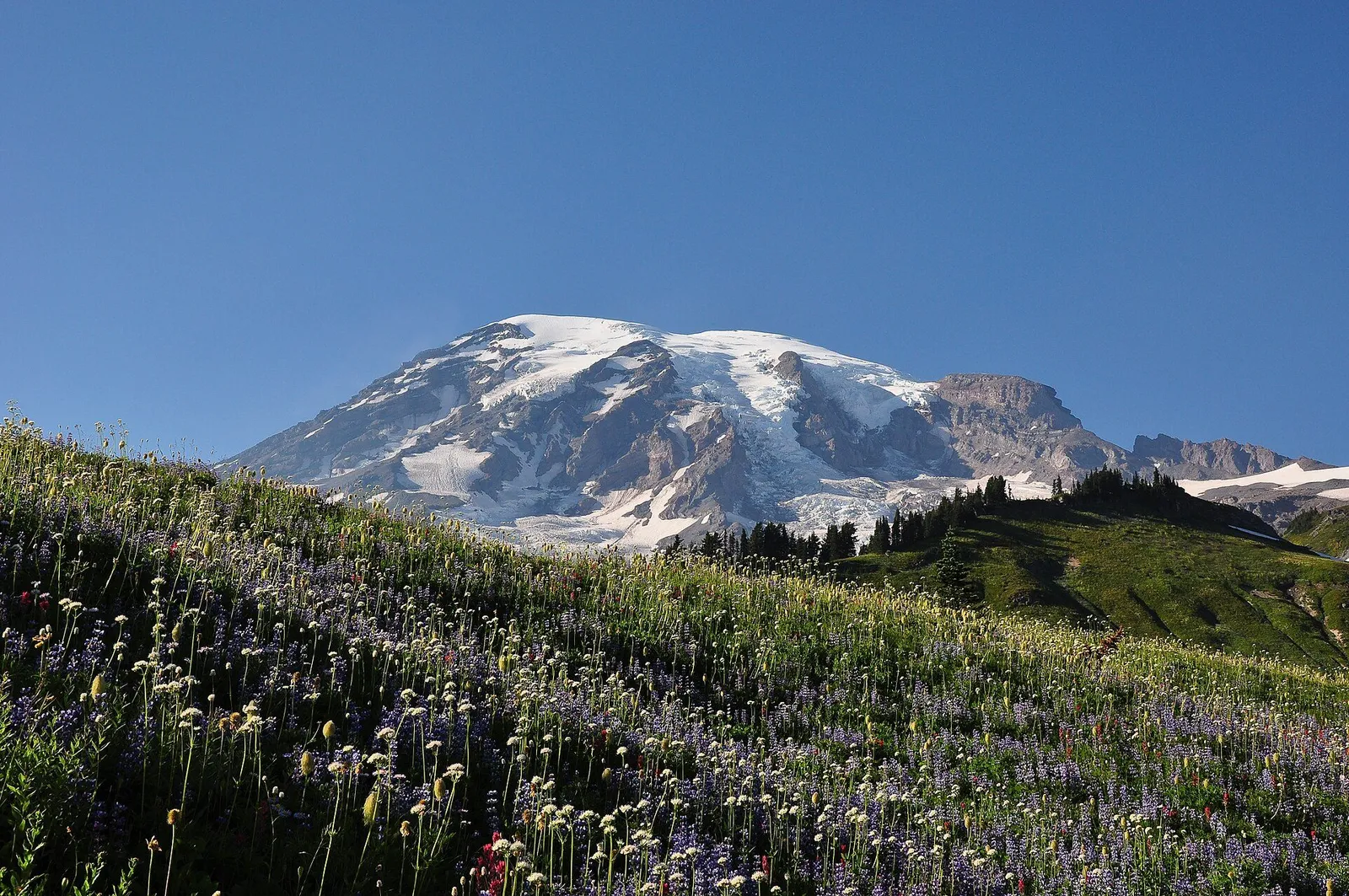
The Pacific Northwest is the rare American region where the itinerary barely fights geography: Seattle, one volcano, Portland and one beach town sit within a three-hour drive of each other, and the loop packs a city food scene, a glaciated volcano, a river gorge and a Pacific beach into one week. The order matters more than the list: do Seattle first because you will not want a car there, take the mountain midweek when the parking lots are emptiest, and finish on the Oregon coast, which points your return at Portland’s airport anyway. Book the mountain day and the falls permit early, and keep a rain jacket in the daypack even in August, because this corner writes its own weather.
Day 1: Arrive in Seattle, Pike Place and the Waterfront
Land at SEA-TAC and take the Link light rail into downtown for a few dollars, because Seattle is the one base on this trip that works better without a car. Spend the afternoon at Pike Place Market: the fish-throwing counters, the flower stalls and the original coffee queues are touristy and still worth an hour, then eat lunch at one of the market counters upstairs with the Elliott Bay view. Walk the new waterfront boardwalk down to the aquarium, and end at the Public Market’s overlook at dusk. Table service tips run 18 to 22 percent (our tipping guide covers the details), and Seattle adds its own sales tax on top of menu prices.
Practical tip: Buy a regional transit card at the airport station and load it once: Seattle’s buses, ferries and light rail all take it, and parking downtown runs US$40 to 60 a night at hotels, which is the car-hater’s opening argument.
Day 2: Seattle Center, Kerry Park and the Bainbridge Ferry
Morning: Seattle Center for the Space Needle (book timed tickets at spaceneedle.com; adult fares have recently run around US$50, and the observation deck’s glass floors do the arguing for you) and the Chihuly Garden and Glass next door, which flatters the Needle’s silhouette better than the Needle itself. Afternoon: drive-rideshare up to Kerry Park on Queen Anne Hill, the postcard viewpoint where the skyline lines up against the Olympics, then walk on to the Bainbridge Island ferry: a 35-minute crossing with downtown receding behind you, mountains ahead, and a walk-on fare around US$10 round trip. Dinner back downtown in the Chinatown-International District.
Practical tip: Do the ferry at sunset on a clear day and stand on the left (west) railing outbound: Rainier glows behind the city on departure and the Olympics fill the window on return, and walk-on passengers ride far cheaper than cars, which queue for an hour in summer.
Day 3: Seattle to Mount Rainier: the Paradise Side
Collect the rental this morning and drive two to two and a half hours to the park’s Nisqually entrance (US$30 per vehicle, seven days, card only; note that Washington’s Discover Pass does not cover national parks, so do not waste US$35 on the state pass by mistake). Spend the afternoon on the Paradise side at 5,400 feet: the Skyline Trail’s marmots and, from mid-July through August, one of North America’s great wildflower meadows under the mountain’s icefalls. In recent summers the park has piloted timed-entry systems for the Paradise corridor, so check nps.gov/mora before you go and reserve on recreation.gov if the pilot is running. Overnight in Ashford or Packwood, the two gateway villages.
Practical tip: Paradise means it: arrive before 10 a.m. or after 4 p.m. in summer, because the lot fills and rangers turn cars away at the gate, and bring real layers, since the summit generates its own weather and 40-degree afternoon swings are normal.
Day 4: Rainier Morning, Drive to Portland
Give the mountain one more morning: the Grove of the Patriarchs’ old-growth boardwalk or the reflection ponds on the Stevens Canyon side if the road is open, since some corridors open late after snow (the park’s road status page is the truth, published at nps.gov/mora). After an early lunch, point south: Ashford to Portland is about two and a half hours, and by late afternoon you are eating your way through Portland’s food-cart pods, where a full meal runs US$10 to 15 and no reservation exists to fight for. Oregon has no state sales tax, so the sticker price is the whole price, a small psychic vacation after Seattle’s.
Practical tip: Do not gamble on mountain roads in the afternoon: snow closes high corridors well into June some years, so check the road status the night before and pick your morning loop from what is actually open, not from guidebook seasons.
Day 5: Portland: Gardens, Books and Food Carts
A city day, and Portland repays it. Morning: Washington Park for the Portland Japanese Garden, widely called the most authentic outside Japan, and the adjacent rose garden, free and at its peak in June. Afternoon: Powell’s City of Books occupies a full city block and swallows an hour like fifteen minutes, and the downtown food-cart pods and Old Town beer history handle lunch. If shopping is the mission, no sales tax makes even ordinary purchases cheaper than home for most European and UK visitors. Evening: the eastside neighborhoods (Alberta Arts, Division Street) for dinner, which is where Portlanders actually eat.
Practical tip: Washington Park charges for parking and fills on sunny weekends, so take the free Washington Park shuttle from the light-rail station at the zoo’s stop, which is also where the Japanese Garden’s timed tickets (book at japanesegarden.com) pair neatly with a morning arrival.
Day 6: Columbia River Gorge to Cannon Beach
Check out early and drive 30 minutes east into the Columbia River Gorge. Multnomah Falls is the headline: a 611-foot two-tiered drop, with the stone Benson Footbridge crossing the lower tier; in recent summers the main viewing area has required a low-cost timed-use permit booked via recreation.gov, so check the Columbia River Gorge National Scenic Area page on fs.usda.gov for the current season’s rules before assuming walk-up access. Give the falls two hours, stop at Vista House’s crown view on the historic highway, then drive west past Portland to the coast: about three hours door to door, landing in Cannon Beach for late-afternoon light on Haystack Rock, the 235-foot sea stack with tidepools at its base and puffins nesting on its face in summer.
Practical tip: The gorge’s waterfalls run their fullest in spring and their most crowded in August; do Multnomah before 9 a.m. either way, because the lot and the bridge line both quadruple by noon, and the coast will be 15 degrees cooler than Portland, so the layers come back out.
Day 7: Cannon Beach Morning, Then Home
Ecola State Park, just north of town, serves the trip’s farewell view: the coastline curving south with Haystack Rock offshore from a headland meadow, reached on a short walk from the parking area (a small per-car day-use fee applies; check the Oregon State Parks page for current access status, as this stretch has had weather closures). Back in town, walk the beach at low tide when the tidepools starfish and anemones appear at Haystack’s base, get a last breakfast on Hemlock Street, and drive 90 minutes to Portland International for afternoon departures, returning the rental with a full tank on the way.
Practical tip: Book your departure flight for after 2 p.m.: the coast’s morning fog regularly slows the drive inland, and PDX’s rental returns run smoothest when you are not negotiating fog on Highway 26 with a boarding time in your inbox.
Practical Notes
Intercity transport (one rental car, roughly 450 driving miles)
| Leg | Distance | Drive time | Notes |
|---|---|---|---|
| SEA-TAC airport to downtown Seattle | 15 mi | 30 min by light rail | Skip the car until Day 3 |
| Seattle to Mount Rainier (Nisqually) | 95 mi | 2-2.5h | Collect the car Day 3 morning |
| Ashford to Portland | 90 mi | 2.5h | Food carts for dinner |
| Portland to Multnomah Falls | 30 mi | 45 min | Go before 9 a.m. |
| Gorge to Cannon Beach | 140 mi | 3h | Coastal temperature drop |
| Cannon Beach to PDX airport | 80 mi | 1.5h | Full tank before the return |
This is the shortest-haul road trip on this site: no leg exceeds three hours, a standard sedan handles everything, and one rental car covers only four of the seven days. Seattle proper works on light rail, buses, ferries and rideshares; renting it early buys nothing but hotel parking fees.
Fees, permits and season (as of October 2026)
- Mount Rainier NP: US$30 per vehicle, 7 days, card only at entrances; the Washington Discover Pass covers state parks only, not the national park; in recent summers the Paradise corridor has piloted timed entry, so check nps.gov/mora and reserve via recreation.gov if required
- Multnomah Falls: free in principle, but the main viewing area has required a low-cost timed-use permit via recreation.gov in recent summers (check the fs.usda.gov Columbia River Gorge page for the current season)
- Bainbridge ferry: walk-on fare around US$10 round trip, charged on the westbound leg; cars pay more and queue
- Portland Japanese Garden: timed tickets booked ahead at japanesegarden.com
- Ecola State Park: small per-car day-use fee; access status varies after storms, check stateparks.oregon.gov
- Weather reality: July to September is the honest season; June runs gray (“Juneuary” is a local word), and the coast sits 10 to 15 degrees cooler than Portland year round
Budget estimate (per person, 7 days, excluding flights, assuming two share car, fuel and rooms)
- Backpacker: US$1,100-1,700. Hostels and motels, food carts and markets, ferry and viewpoints, one paid tower
- Mid-range: US$2,000-3,000. Boutique hotels in Seattle and Portland, a Cannon Beach resort night, restaurant dinners, all gardens and towers
- Comfort: US$3,500-6,000. Oceanfront rooms on the coast, tasting-menu nights, a guided Rainier hiking day
Hotel parking (US$40-60 a night in Seattle) and resort fees on the coast are the quiet budget killers here, so price rooms through our Real Price Calculator before you commit; Oregon’s lack of sales tax softens the retail damage.
Car vs plane vs train verdict
One rental car, collected in Seattle on Day 3 and dropped at PDX on Day 7, is the whole verdict. Trains do not connect this loop usefully (the Amtrak Cascades runs Seattle to Portland, a nice fallback if you want to skip one drive, but useless for the mountain and the coast), and flying between cities 150 miles apart makes no sense. Two safety notes: Rainier’s trails sit above 5,000 feet with real weather, and the region’s hospitals are hours from the mountain gate, so carry layers, water and medical insurance, because American emergency care without coverage is a five-figure surprise (our health and safety guide covers what to carry).
Sources & verification (10)
- https://www.nps.gov/mora/planyourvisit/fees.htm
- https://www.nps.gov/mora/planyourvisit/index.htm
- https://www.fs.usda.gov/r06/columbia-river-gorge
- https://www.multnomahfalls.org/
- https://www.spaceneedle.com/
- https://www.pikeplacemarket.org/
- https://wsdot.wa.gov/travel/washington-state-ferries
- https://stateparks.oregon.gov/
- https://trimet.org/
- https://www.japanesegarden.com/