American Food for First-Timers: Portions, Tipping, and What to Eat Where
Eating out in the United States runs on mechanics that surprise even travelers from Britain, Ireland and Australia: portions that could feed two, checks that arrive unasked, a tipping system that is a wage rather than a bonus, and a gratuity line that may already be on your bill. This guide covers those rules first, then maps the country by plate: Texas barbecue, New England clam chowder, Chicago deep dish, New Orleans creole cooking and California's produce-driven plates, plus brunch culture and the food truck boom. It closes with a plain-language script for ordering with allergies or dietary restrictions. Tipping rates, allergen labeling and menu history verified as of October 2026.
The short version
- Portions run large: one casual-restaurant entree often feeds two lighter appetites, and asking for a to-go box is completely normal
- Sit-down service means a tip of 18-22 percent of the pre-tax bill; check for a gratuity line first so you do not tip twice
- Order by region: smoked brisket in Texas, clam chowder in New England, deep dish in Chicago, creole in New Orleans, produce-driven plates in California
- Servers do not hover for payment: the check is dropped on the table and you pay when you are ready
- State allergies clearly and early: US packaged food labels must cover nine major allergens, including sesame
You will eat well in the United States, but the mechanics take a day or two to learn. Portions are bigger than at home, the check arrives before you ask for it, and the tip is not a thank-you, it is the server’s wage. Then there is the fun part: this is an enormous country with genuinely regional food, and the best meals come from ordering the local thing in the right place. Here is how all of it works.
Portions Are Bigger Than You Expect
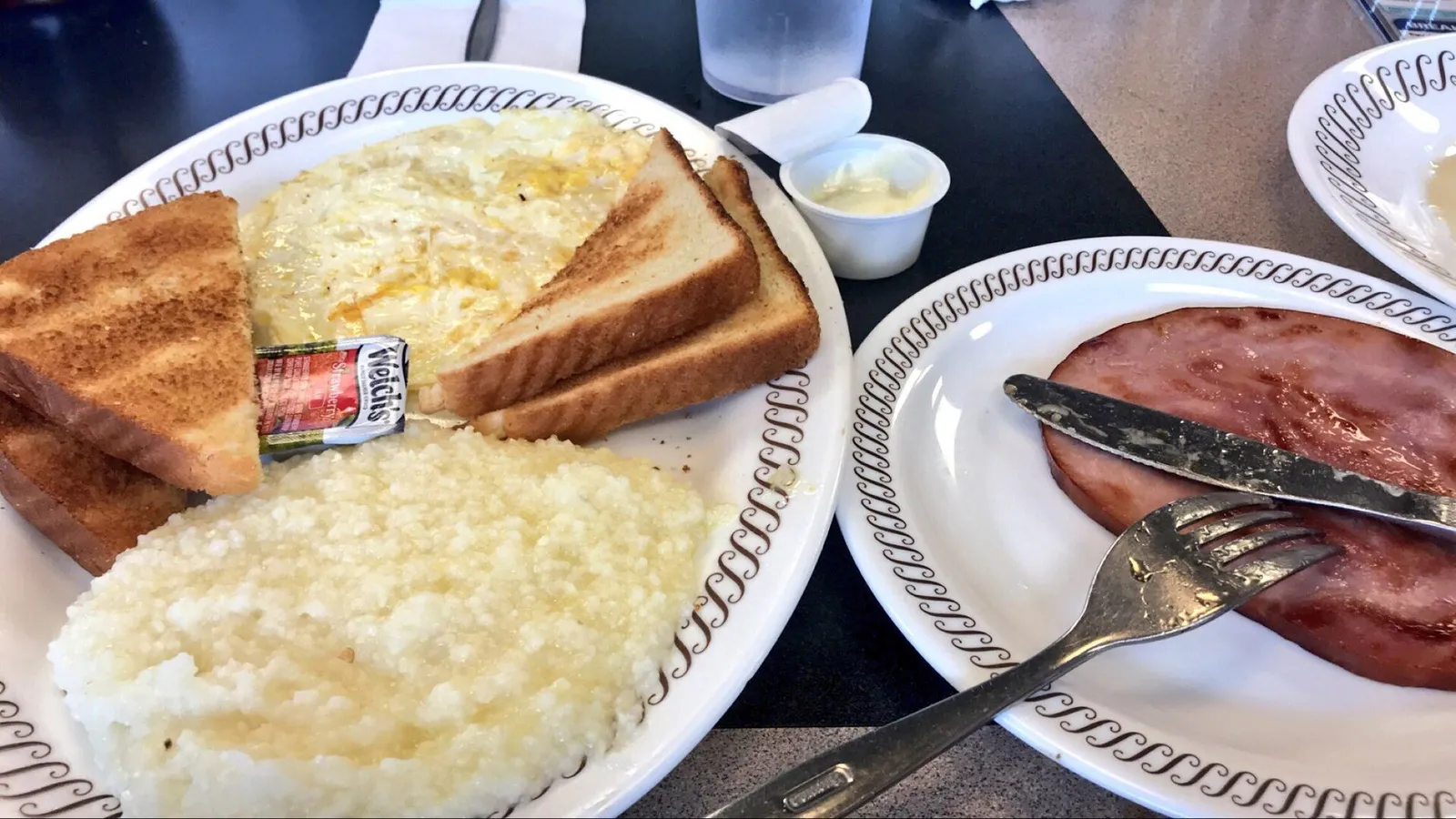
Casual American kitchens plate generously. A single entree at a diner or casual chain is routinely a full plate plus two sides, an appetizer can be a meal, and drinks come in sizes that start where a European large ends. Nobody is trying to overcharge you; this is simply the standard serving culture, and it is why you see so many Americans leave restaurants with a foam box.
Three habits solve the problem. First, at counter-service and casual spots, one entree plus one shared starter comfortably feeds two lighter eaters. Second, ask for a to-go box the moment you slow down; leftovers are so normal that servers often offer before you ask. Third, match the restaurant to your hunger: a “small” plate or a side order at a barbecue counter is often the right size for one person. Soft drinks at casual places are usually refillable and tap water is free on request, so order the expensive drinks, not the food, when you want to cut the bill.
Diners, Chains, and How American Restaurants Are Organized
The diner is the institution to know. Many of the earliest were converted rail dining cars, and from the 1920s to the 1940s new ones were factory-prefabricated and delivered to small city lots, which is why the classic ones are long and narrow (see the diner entry in Wikipedia for the full history). What matters to you: booths plus a counter with direct service, breakfast served all day, big coffee mugs, and many small-town diners open 24 hours because highway traffic never stops.
The wider landscape breaks down like this:
| Type | What it is | How you pay and tip |
|---|---|---|
| Diner | Booth-and-counter spot, all-day breakfast, locals’ breakfast HQ | Sit-down rules: 18-22 percent |
| Fast food | Order at counter, tray or drive-through | No tip expected |
| Fast casual | Order at counter, real plates and better ingredients | No tip expected; tip jar optional |
| Casual sit-down chain | Table service, big menus, families | 18-22 percent |
| Fine dining | Reservations, courses, professional service | 18-22 percent, often on larger totals |
| Food truck | Order at a window, eat outside or takeaway | No tip expected, round up if happy |
One vocabulary alert for British and Irish readers: an “entree” is the main course, a “biscuit” is a savory scone-like bread that comes with gravy, “chips” are fries, and “main” appears on almost no menu. Order using American words and you will never get a surprise.
Tipping: Read the Bill Before You Add Anything
Tipping in the US is not a bonus, it is the wage. Federal law allows employers to pay tipped staff a base of $2.13 per hour, with tips expected to bring earnings up to the standard minimum wage (this is the “tip credit”, summarized in Wikipedia’s tipped wage article, citing Department of Labor rules). Whatever you think of the system, the server’s income depends on you.
The current baseline, as of October 2026 and covered in detail in our tipping and sales tax guide:
| Situation | Tip |
|---|---|
| Table service at a restaurant | 18-22 percent of the pre-tax total |
| Bartender | $1-2 per drink |
| Food delivery | 10-15 percent |
| Counter service and coffee shops | Nothing expected; jar optional |
Two traps to dodge. First, the included gratuity: at many restaurants, parties of six or more are automatically charged a gratuity or “service charge” of around 18-20 percent, printed on the bill. Read the bill before adding anything, because adding a second 20 percent is the single most common first-timer mistake. Second, the payment dance: your server drops the check without being asked, you put your card on it, they return a slip with a tip line, you write the tip and total and leave. Nobody comes to collect while you are still talking.
The Regional Map: What to Eat Where
This is a continental food culture, and the regions really do taste different. Order the signature, not the safe option:
| Region | Signature | What you are ordering |
|---|---|---|
| Texas (and Kansas City, Memphis, the Carolinas) | Barbecue, each region its own style | Smoked beef brisket by the half pound in central Texas; burnt ends in Kansas City; dry-rub ribs in Memphis; pork with vinegar sauce in the Carolinas |
| New England | Clam chowder and lobster rolls | Chowder here is cream-based and dates to the 18th century; if a menu offers Manhattan chowder, that is the tomato-based cousin |
| Chicago | Deep dish pizza | Invented at Pizzeria Uno in 1943; a cheese layer under chunky tomato sauce on top, baked in a pan; expect a longer bake time, so order before you are starving and share one |
| New Orleans | Creole and Cajun cooking | Gumbo, the official state dish of Louisiana, plus jambalaya, red beans and rice, beignets; the south Louisiana pantry of shellfish, rice and spice |
| California | Produce-driven cooking | Farmers-market salads, fish tacos, avocado everything, wine-country plates; the freshest-tasting food in the country |
| The Southwest | Tex-Mex and border food | Burritos, enchiladas, chile sauces; portions get even bigger |
The action here is simple: before each city stop, look up its two or three local dishes and commit to trying them. In Boston that is chowder and a lobster roll, not a cheeseburger. In New Orleans it is gumbo, not pasta.
Brunch and Food Trucks
Two eating habits are worth building a morning or a lunch around. Brunch is the weekend social meal, roughly 10 a.m. to 2 p.m., mixing breakfast food with savory plates and, for many, a Bloody Mary or mimosa. Popular brunch spots run real waits, so put your name in, walk around, come back. One hard rule while drinks are involved: the legal drinking age is 21 nationwide, set by the 1984 National Minimum Drinking Age Act, and ID checks are routine even for travelers who look well past 18.
Food trucks went from lunch wagons to a genuine culinary movement in the late 2000s, and cities like Los Angeles, Austin and Portland, Oregon now treat them as anchors of the food scene rather than a compromise. The trucks cluster where office lunch crowds are on weekdays and at designated pods or markets on weekends. Search “food trucks” in Google Maps, sort by rating, and you can eat very well for $10-15 per person.
Eating with Allergies or Dietary Restrictions
The US takes allergies seriously once it knows about them, and the labeling side is strong: federal rules require packaged foods to declare nine major allergens, milk, eggs, fish, crustacean shellfish, tree nuts, peanuts, wheat, soybeans and sesame, per the FDA’s food allergen guidance. Restaurants are not label-regulated the same way, so the burden is on you to speak up, and the system is built to respond.
How to do it, in order:
- Say the word “allergy” at the start of the order, not “I don’t eat” or “I’m not keen on”. “I have a severe peanut allergy” triggers a different kitchen response than a preference, and staff are trained to flag the kitchen, check ingredients and tell you honestly what they cannot guarantee.
- Ask directly: “Does this contain or touch nuts, shellfish or wheat?” Cross-contact is a fair question in any American kitchen, and buffet-style places are the ones to avoid if your allergy is severe.
- For serious allergies, carry your medication and say “severe” out loud. Emergency services use 911 nationwide if anything goes wrong.
- Vegetarian and vegan eating is easy in cities and completely normal everywhere urban; gluten-free menus are common too. Where choices run thin, every mid-size US town has a supermarket with a salad bar and a hot food counter, which is a reliable fallback rather than a defeat.
Common Mistakes
- Waiting for the check. It does not come until you ask, or rather, it is simply left with you earlier than you expect. When you want to go, signal the server or walk to the counter in casual places.
- Tipping 10 percent like at home, or tipping twice. Table service is 18-22 percent, and if the bill says “gratuity included”, you are done. Read every bill.
- Tipping at fast food counters. Nobody expects it. The tip jar is a gesture, not a system.
- Eating highway-exit chains all trip. Chains are fine and predictable, but you will remember the regional plates. Two minutes of research per city buys the whole meal.
- Ordering a deep dish each. Deep dish serves two, bakes long, and is the heaviest pizza you will meet. One pie, shared, ordered early.
- Reading “biscuits and gravy” as a sweet snack. It is a savory breakfast of soft bread with sausage gravy, and it is excellent. Just know what is coming.
- Softening allergy language. “I’m coeliac” or “severe allergy” gets you a kitchen conversation; “I try to avoid gluten” gets you a shrug. Be direct, every time.
Sources & verification (9)
- https://www.fda.gov/food/food-labeling-nutrition/food-allergies
- https://en.wikipedia.org/wiki/Tipped_wage
- https://en.wikipedia.org/wiki/Chicago-style_pizza
- https://en.wikipedia.org/wiki/Clam_chowder
- https://en.wikipedia.org/wiki/Barbecue_in_the_United_States
- https://en.wikipedia.org/wiki/Cajun_cuisine
- https://en.wikipedia.org/wiki/Diner
- https://en.wikipedia.org/wiki/National_Minimum_Drinking_Age_Act
- https://en.wikipedia.org/wiki/Food_truck